Blog › Head-to-head
Rosie vs Smith.ai
These are opposite ends of the same market. Rosie is an AI Sales Agent starting at $49/month for 250 minutes, with calendar booking and transfers from the $149/month Scale tier. Smith.ai is a live human receptionist service starting at $300/month for 30 calls, then $11.50 per additional call.
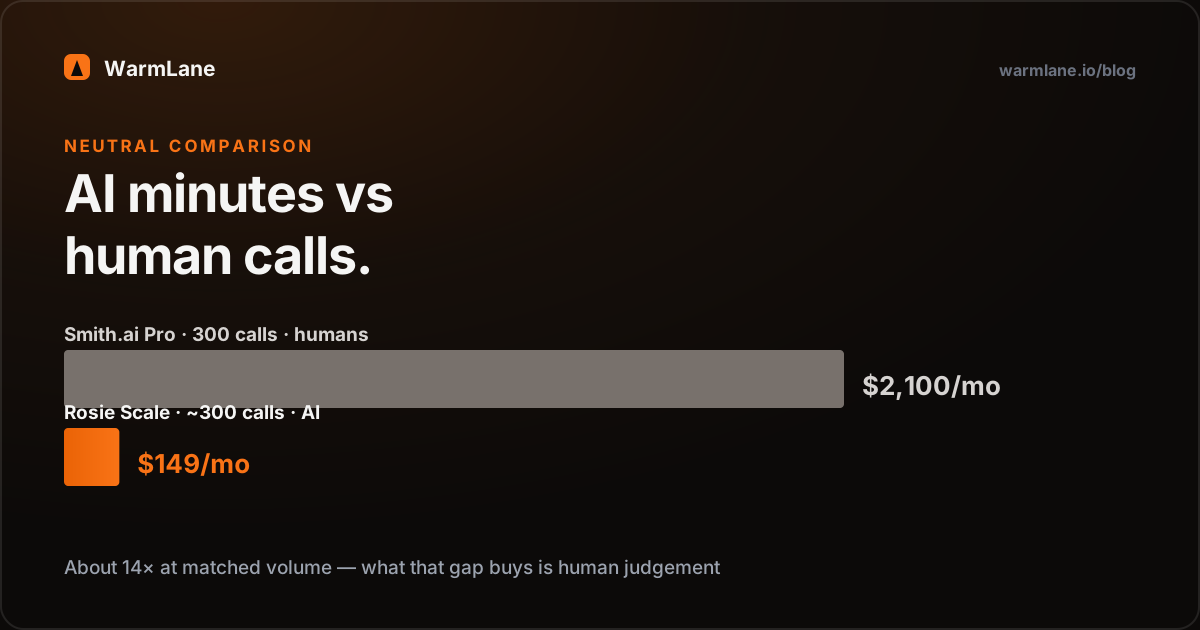
At comparable volume the gap is enormous. Roughly 300 calls a month costs about $149 on Rosie Scale and $2,100 on Smith.ai Pro - around fourteen times more. That is not Smith.ai overcharging; it is what employing trained people costs versus what running software costs.
Choose Rosie if your inbound is mostly routine - booking, hours, service area, qualification - and you want to answer far more calls for far less. Choose Smith.ai if your calls carry professional liability or emotional weight, if you need outbound follow-up as well as answering, or if a human voice is part of what clients are paying you for.
This comparison is published by Warmlane, which sells a competing AI Sales Agent - it answers every call, then qualifies the caller, handles the price question and books the job. We have kept the analysis below neutral and sourced every figure to each vendor's own pricing page, because a comparison you can't trust is worthless to you and to us. Warmlane appears once, in its own clearly-labelled section near the end. Judge the rest on the citations.
What each one costs
| Rosie - AI, metered by minute | Monthly | Included | Booking & transfers |
|---|---|---|---|
| Professional | $49 | 250 minutes | No |
| Scale | $149 | 1,000 minutes | Yes |
| Growth | $299 | 2,000 minutes | Yes |
| Smith.ai - human, metered by call | Monthly | Included | Each extra call |
|---|---|---|---|
| Starter | $300 | 30 calls | $11.50 |
| Basic | $810 | 90 calls | $10.50 |
| Pro | $2,100 | 300 calls | $8.50 |
| Enterprise | Custom | Custom | Custom |
Sources, both read 29 September 2026: heyrosie.com/pricing and smith.ai/pricing. Rosie plans include a 7-day free trial, 24/7 availability, multilingual support, spam detection and a website chat widget; Professional includes 2 custom message-taking scenarios, Scale 5 plus booking and warm/live transfers, Growth unlimited scenarios plus waterfall transfers, custom agent training and white-glove onboarding. Rosie does not publish a minutes overage rate. Smith.ai states no setup fees, no overseas agents, a 30-day money-back guarantee and month-to-month billing, with 1, 2 and 10 free transfer destinations by tier. Vendors change pricing without notice.
The two are metered on different units, which makes direct comparison impossible until you convert them. That is the next section, and it is where the decision usually gets made.
Cost at the same call volume
Converting Rosie's minutes to calls at a three-minute average, and taking the cheapest available plan on each side at each volume:
| Calls / month | Rosie plan | Rosie cost | Smith.ai plan | Smith.ai cost | Multiple |
|---|---|---|---|---|---|
| 30 | Professional* | $49 | Starter | $300 | 6.1× |
| 80 | Professional* | $49 | Starter + 50 @ $11.50 | $875 | 17.9× |
| 100 | Scale | $149 | Basic + 10 @ $10.50 | $915 | 6.1× |
| 300 | Scale | $149 | Pro | $2,100 | 14.1× |
| 600 | Growth | $299 | Pro + 300 @ $8.50 | $4,650 | 15.6× |
Our own arithmetic from the published plans above, assuming a three-minute average inbound call to convert Rosie's minute allowances into call counts. *Rosie Professional does not include calendar booking or transfers - at 30 and 80 calls it is only a like-for-like comparison if you need message taking rather than booking; if you need booking, use the Scale row. Real average call length varies by industry, and legal or medical intake runs considerably longer than three minutes, which shifts Rosie's effective call capacity down. Rosie does not publish a minutes overage rate.
Two honest caveats about that table, because a 14× multiple invites over-reading.
The three-minute assumption does a lot of work. Smith.ai bills per call regardless of length, so long calls are relatively better value there. If your average intake conversation runs eight minutes, Rosie Scale's 1,000 minutes covers only about 125 calls, not 333, and the multiple narrows considerably. Businesses with long consultative calls should redo this table with their own number.
You are not buying the same thing. A human handles a caller who is upset, confused, or describing something that does not fit any script. That capability is what the multiple pays for. Whether it is worth 14× depends entirely on how often your callers need it.
What each can actually do
| Rosie | Smith.ai | |
|---|---|---|
| Structure | ||
| Answered by | AI | Human receptionists |
| Billing unit | Minutes | Calls |
| Setup fee | None | None |
| Who configures it | You do | Smith.ai does |
| Risk-free period | 7-day trial | 30-day money-back |
| On the call | ||
| 24/7 coverage | Yes | Yes |
| Simultaneous callers | No limit | Subject to staffing |
| Calendar booking | Scale tier and above | Yes |
| Transfer to a human | Scale tier and above | Yes |
| Complex or distressed callers | Limited | Yes |
| Outbound follow-up | No | Yes |
| Multilingual | Yes | Yes |
| Spam detection | Yes | Yes |
| Beyond voice | ||
| Website chat widget | All tiers | Available |
| Transcripts | Yes | Yes |
Compiled 29 September 2026 from heyrosie.com/pricing and smith.ai/pricing. "Subject to staffing" reflects an inherent property of any human-staffed service rather than a published limitation. "Limited" on complex callers reflects the general state of AI phone agents in 2026, not a specific Rosie limitation - the same caveat applies to every AI Sales Agent, ours included.
The quality trade-off, honestly
The genuinely useful framing is not "is AI as good as a person" - on a hard call it is not, and anyone claiming otherwise is selling something. The useful question is what happens to each individual call under each option.
With Smith.ai, calls reach a trained person and are handled well. Every call. The quality floor is high and consistent, and that consistency is a large part of what you are buying. The constraint is that each one costs $8.50 to $11.50, so most businesses cap what they route there. Calls outside the cap go to voicemail, which is a quality floor of zero.
With Rosie, every call is answered instantly regardless of volume or hour. Routine calls are handled properly. Difficult calls are handled less well than a person would, though on Scale and above the agent can transfer to a human. The quality ceiling is lower; the quality floor across your whole call volume is usually higher, because nothing gets left ringing.
Most owners assume their problem is the difficult calls. When they read their own transcripts, they discover it was the ordinary ones nobody answered.
Which suits which business
Trades and home services with high volumes of short, routine calls. Salons, clinics and studios taking bookings and reschedules. Businesses with heavy after-hours or weekend inbound. Anyone whose calls currently go to voicemail because a human service would be unaffordable at their volume. Solo operators who need message taking and nothing more - the $49 tier is genuinely cheap for that.
Law firms running intake and conflict checks. Medical and dental practices where triage judgement matters. Financial and professional services where the first voice is part of the brand promise. Businesses needing outbound follow-up and lead chasing, not just answering. Anyone with low call volume and high per-client value, where $300/month is trivial against one won client.
The rough test: divide your average client value by your monthly call volume. If a single won client covers several months of Smith.ai, the human service is easy to justify. If you need volume and speed more than nuance, the AI side wins on arithmetic that is not close.
A third option worth knowing about
Since this page is published by Warmlane, here is our own position stated plainly and then left alone.
Rosie's constraint is that its capable tier is minute-metered at $149/month, and you build the agent yourself. Smith.ai's constraint is per-call pricing that makes your busiest months your most expensive. Warmlane is a third model: $39.50/month (founding price for our first 50 customers, locked for life; list $79), unlimited inbound calls, booking and transfers included, and our team builds and tunes the agent for you at no extra cost.
That will not suit everyone - we are AI, so the Smith.ai judgement argument applies to us in full, and we do not offer website chat as Rosie does. But if the thing pushing you toward Smith.ai is capacity rather than judgement, a flat unlimited plan is worth pricing before you commit to per-call billing.
Whichever way you're leaning, hear an AI agent first.
You cannot judge this category from tables. Call ours - it's our live production agent, not a demo reel. Ask it what your customers ask, interrupt it, raise an objection, ask it to book you in. Then you'll know whether AI is even in the running for your business.
+1 (218) 683-6315Warmlane offers a 14-day free trial with no card, Rosie a 7-day trial and Smith.ai a 30-day money-back guarantee, so you can test all three. Warmlane's founding price is $39.50/mo, locked for life for our first 50 customers.