Blog › Buyer's guide
AI Sales Agent pricing compared: 9 services, every price verified
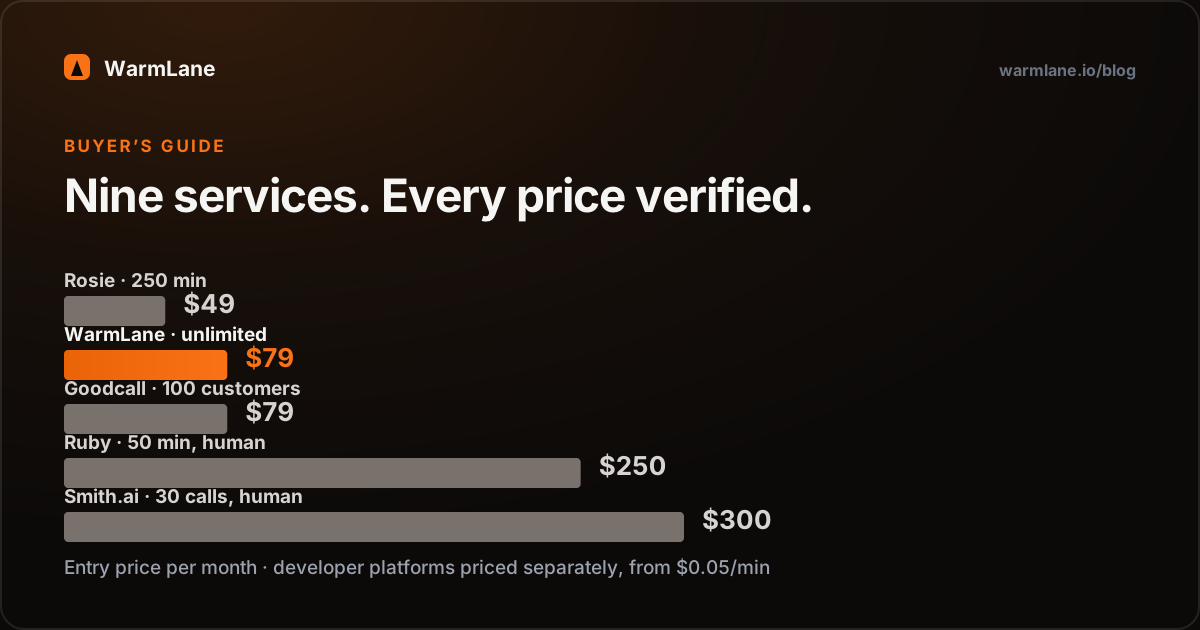
AI Sales Agent pricing in 2026 spans $39.50/month to $2,500/month, and the spread is mostly explained by which of four billing models a vendor uses - flat, per minute, per call, or per unique customer.
AI Sales Agents: Warmlane $39.50/mo (founding price for our first 50 customers, locked for life; list $79) with unlimited calls, Rosie from $49/mo (250 minutes), Goodcall from $79/mo per agent (100 unique customers). Warmlane sits in this group because it does the AI Sales Agent job, but it is built as an AI Sales Agent: it also qualifies the caller, handles the price question and books the job.
Human answering services: Ruby from $250/mo (50 minutes), Smith.ai from $300/mo (30 calls), AnswerConnect quote-only with a $49.99 setup fee.
Developer platforms (you build the agent): Vapi $0.05/min plus model costs, Retell $0.07–$0.31/min all-in, Synthflow from $30,000/year.
The headline price is rarely what you pay. Three things move it: whether booking is included at the entry tier, whether there is a usage cap and what it costs to exceed it, and how long your call records are kept before deletion.
The master pricing table
Every figure below was read off the vendor's own public pricing page on 29 September 2026. Nothing here is recalled, estimated, or copied from another comparison article.
| Service | Type | Entry price | What that includes | Billing model | Booking at entry |
|---|---|---|---|---|---|
| AI Sales Agents - finished products | |||||
| Rosie | AI | $49/mo | 250 minutes | Per minute | No - $149 tier |
| Warmlane | AI | $39.50/mo founding (list $79) | Unlimited calls | Flat, per agent | Yes |
| Goodcall | AI | $79/mo per agent | 100 unique customers | Per unique customer | Yes |
| Human answering services | |||||
| Ruby | Human | $250/mo | 50 minutes | Per minute | Yes |
| Smith.ai | Human | $300/mo | 30 calls | Per call | Yes |
| AnswerConnect | Human | Not published | Not published | Per minute | Yes |
| Developer platforms - you build the agent | |||||
| Vapi | Platform | $0.05/min | Hosting only | Per minute + models | You build it |
| Retell | Platform | $0.07–$0.31/min | All-in per minute | Per minute | You build it |
| Synthflow | Platform | $30,000/year | Enterprise contract | Scoped per customer | Included in scope |
Sources, all read 29 September 2026: Rosie · Goodcall · Ruby · Smith.ai · AnswerConnect · Vapi · Retell · Synthflow · Warmlane at warmlane.io/pricing. AnswerConnect does not publish plan pricing; registration or a sales call is required, and a $49.99 one-time setup fee is documented. Vendors change pricing without notice - verify before purchasing, and treat this as a dated snapshot.
The four billing models
Comparing headline prices across these nine is meaningless until you understand that they are not selling the same unit. Here is what each model rewards and punishes.
Flat rate (Warmlane)
One price, no metering. Rewards high and unpredictable volume - a busy month costs the same as a quiet one, so a call spike is unambiguously good news. Punishes very low volume, where you are paying for capacity you do not use. Best when you want cost certainty and every call answered.
Per minute (Rosie, Ruby, AnswerConnect, Vapi, Retell)
You buy an allowance of talk time. Rewards short calls and low volume. Punishes long consultative conversations - and creates a perverse incentive, because your best calls are usually your longest. An agent that talks a hesitant caller into booking necessarily costs more than one that lets them hang up.
Watch for rounding. AnswerConnect rounds up to the nearest minute, so a 65-second call bills as two. If your calls are short, rounding can add 30–50% to effective consumption.
Per call (Smith.ai)
Each conversation is one billable unit regardless of length. Rewards long calls - a twelve-minute intake costs the same as a thirty-second wrong number. Punishes high volume of short routine calls, which for most trades and clinics is the bulk of inbound. This is why Smith.ai suits legal and professional intake far better than it suits a plumbing dispatch line.
Per unique customer (Goodcall)
The newest model. You are billed on distinct people served per month, not calls or minutes. More forgiving than the others - a repeat caller does not cost twice within the period, and Goodcall makes minutes and tokens unlimited. But it still rises with your marketing: the month your ad campaign works is the month your software bill goes up.
What you pay at 30, 100 and 300 calls
The only fair comparison is at matched volume. Below, each vendor is placed on its cheapest plan that covers that volume, assuming a three-minute average call.
| Service | 30 calls/mo | 100 calls/mo | 300 calls/mo |
|---|---|---|---|
| Rosie (message taking only) | $49 | $149 | $149 |
| Rosie (with booking) | $149 | $149 | $149 |
| Warmlane | $39.50 | $39.50 | $39.50 |
| Goodcall | $79 | $79 | $129–$249* |
| Ruby | $395 | $1,725 | Above published tiers |
| Smith.ai | $300 | $915 | $2,100 |
Our own arithmetic from the published plans above, assuming a three-minute average inbound call. Rosie rows convert minute allowances to calls (250 min ≈ 83 calls; 1,000 min ≈ 333 calls). Ruby: 30 calls ≈ 90 minutes → Professional $395; 100 calls ≈ 300 minutes → Enterprise $1,725 (500 min); 300 calls ≈ 900 minutes exceeds Ruby's published ladder. Smith.ai: 30 → Starter $300; 100 → Basic $810 + 10 overage @ $10.50 = $915; 300 → Pro $2,100. *Goodcall meters unique customers, not calls - 300 calls from under 100 distinct people stays on Starter at $79, while 300 calls from 300 distinct people needs Growth or Scale. Your position depends entirely on your repeat-caller ratio. AnswerConnect is excluded because it publishes no prices to model. Warmlane figures are the founding price for our first 50 customers, locked for life (list $79). Real call length varies by industry; legal and medical intake runs considerably longer than three minutes, which shifts every per-minute row.
Two honest observations about that table.
The AI/human gap is structural, not competitive. Smith.ai at 300 calls costs roughly 53 times Warmlane's founding price (about 26 times its $79 list price). That is not Smith.ai overcharging - it is what employing trained people costs versus what running software costs. If your calls need human judgement, the premium buys something real. If they do not, you are paying human rates for lookup work.
Among the AI options, the spread is small. $39.50 to $149 covers all three at most volumes. Nobody in this group is dramatically undercutting anyone. That means price should be roughly the last thing you decide on between AI vendors, and capability, caps and setup model should come first.
Three limits that change the price
These are the things that turn an advertised price into a different actual price. All three are on vendors' own pricing pages; none of them are prominent.
1. Booking is often not at the entry tier
Rosie's $49 plan does not include calendar booking, warm transfers or live transfers. Those start at Scale, $149/month. If the reason you are buying an AI Sales Agent is for calls to end with an appointment, Rosie's real entry price is $149 and comparisons against $49 are not like-for-like.
2. Usage caps and what they cost to exceed
| Service | Cap at entry | Cost to exceed |
|---|---|---|
| Warmlane | None | n/a |
| Goodcall | 100 unique customers | $0.50 each |
| Rosie | 250 minutes | Overage rate not published |
| Ruby | 50 minutes | Overage rate not published |
| Smith.ai | 30 calls | $11.50 per call |
| AnswerConnect | Not published | Not published |
From the vendor pricing pages cited above, read 29 September 2026. "Overage rate not published" means we could not find the figure on the vendor's public pricing page - it is the single most important question to ask any metered vendor before purchasing, because the answer determines your worst-case monthly bill. AnswerConnect does document a $49.99 one-time setup fee, minute rounding, and the first 30 interactions under 30 seconds free per cycle.
3. How long your call records survive
This one surprises people, because it does not surface until you need a transcript and discover it is gone.
- Goodcall Starter: 7 days. 30 days on Growth ($129/mo), unlimited on Scale ($249/mo).
- Vapi pay-as-you-go: 14 days call history. 30 days on Core ($29/mo).
- Warmlane: full history on every plan, with AI analysis and a QA score per call.
Your transcript archive is arguably the most valuable by-product of running an AI Sales Agent - a searchable record of every question your market actually asks, in their own words. A rolling window turns a compounding asset into a buffer. And when a customer disputes a quote from three weeks ago, a seven-day retention policy is not an abstraction.
Prices are easy to compare. Voice quality isn't.
Every table on this page is arithmetic. What actually decides whether an AI Sales Agent works for you is whether it sounds good enough that your customers stay on the line. Ours is a phone call away - the live production agent, not a demo reel.
+1 (218) 683-6315Warmlane: 14-day free trial, no card. Founding price $39.50/mo, locked for life for our first 50 customers. Rosie offers a 7-day trial, Smith.ai a 30-day money-back guarantee - test all of them.
Developer platforms
Vapi, Retell and Synthflow belong in a different conversation. They are infrastructure for building AI phone agents, not finished receptionists, and their per-minute rates look cheap only because the build cost is not on the pricing page.
| Platform | Rate | Concurrency | Retention | You still build |
|---|---|---|---|---|
| Vapi | $0.05/min + models | 4 (10 on Core, $29/mo), then $10/line/mo | 14 days (30 on Core) | Everything |
| Retell | $0.07–$0.31/min all-in | 20, then $8/mo each | - | Everything |
| Synthflow | $30,000/year min. | Custom | Custom | Scoped for you |
From vapi.ai/pricing, retellai.com/pricing and synthflow.ai/pricing, read 29 September 2026. Vapi's $0.05/min covers hosting only; STT, LLM and TTS are passed through at cost. Vapi estimates $82–$129/mo at 1,000 minutes, models included. Retell's range is driven by LLM and voice selection - its components are voice infra $0.055/min, LLM from $0.0032/min to $0.38/min depending on model (e.g. GPT 4.1 $0.045, GPT 5.5 $0.16), TTS $0.015–$0.040/min and telephony $0.015/min. Synthflow's page states enterprise contracts start at $30,000 annually with no self-serve tiers published. Note that older comparison articles group Synthflow with Vapi and Retell as a small-team option; that is out of date.
Starting from Vapi or Retell, a production receptionist still needs the knowledge layer, prompt and persona engineering, calendar booking via function calling, transcript storage and search, telephony routing and failover, monitoring, and a dashboard. For an engineering team building a product to sell, that is the point. For a business that wants its phone answered, it is weeks of work plus permanent maintenance. Full breakdown here.
How to pick a model
Forget the vendors for a moment. Answer these four questions about your own business and the shortlist writes itself.
- How many calls, and how variable? Under 30 a month and stable → metered is honest pricing. Over 100, or spiky → flat rate, or you will be punished for growth.
- How long is your average call? Under three minutes → avoid per-call pricing. Over eight minutes → per-call becomes competitive and per-minute gets expensive.
- Does the call need to end in a booking? If yes, ignore any entry tier that excludes booking, and compare at the tier that includes it.
- Do your calls need human judgement? Legal intake, clinical triage, distressed callers → a human service is worth the 5–25× premium. Booking, hours, service area, qualification → it is not.
Routine calls, spiky volume, want bookings → flat-rate AI. Complex calls, low volume, high client value → human service. Building a product rather than running a business → developer platform. Everything else is detail.