Blog › Industry guide
AI Sales Agent for law firms: what it should and shouldn't do
Law firms are the one category on this blog where we routinely recommend a human answering service over AI for the core job. Smith.ai ($300/month for 30 calls) and Ruby ($250/month for 50 minutes) staff trained people, and legal intake is exactly the work that justifies the premium.
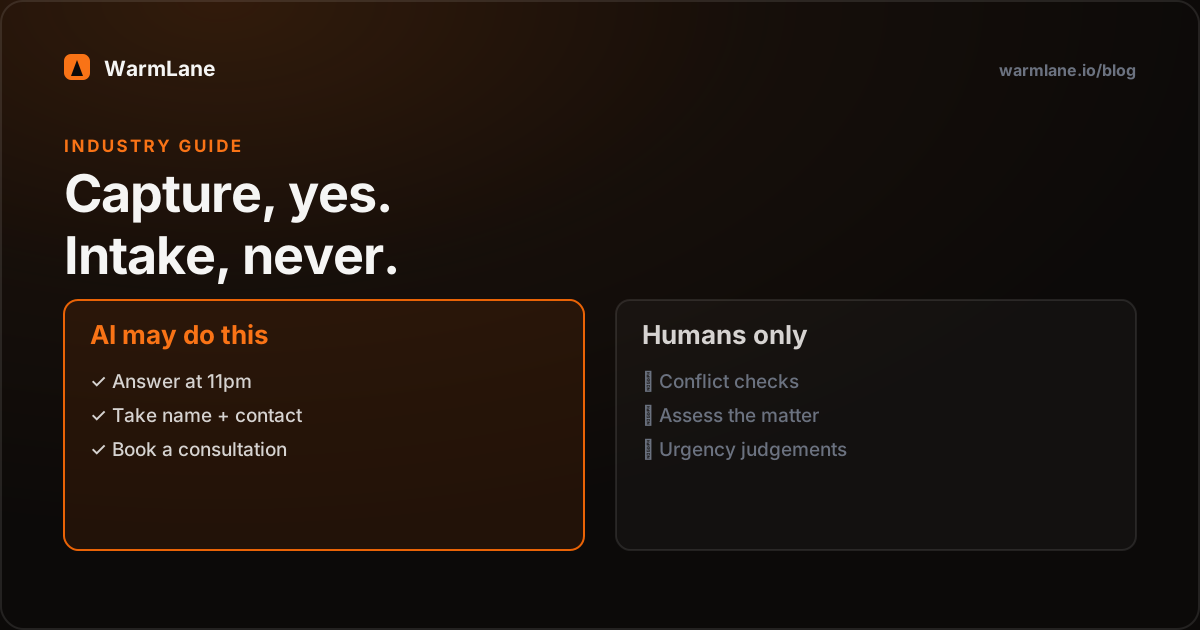
But that is not the whole picture, because "legal intake" and "answering the phone" are different tasks. An AI Sales Agent has a real and narrow role at a law firm: capturing the caller who rings at 11pm, filtering the spam and solicitation calls, taking name and contact details, identifying the broad matter type, and booking a consultation with a qualified attorney.
What it must never do: run or imply a conflict check, assess the merits or urgency of a matter, take detailed privileged facts, quote fees as though engaged, or say anything a caller could reasonably read as legal advice or as forming a relationship.
The right model for most firms is a hybrid: humans do intake, AI makes sure nobody reaches a voicemail box.
Warmlane sells an AI Sales Agent - it answers every call, then qualifies callers, handles common objections and books the appointment - so we have an obvious interest here. We are telling you anyway that AI should not run your intake - because selling a firm the wrong tool for a regulated process is how you end up in a complaint, and that helps nobody. Nothing on this page is legal or ethics advice. Professional conduct rules on confidentiality, supervision of non-lawyer assistance and advertising vary by jurisdiction; check your own bar's guidance before deploying anything that speaks to prospective clients.
The actual problem at most firms
Firms rarely have a "we need AI" problem. They have a speed and coverage problem, and it has two specific shapes.
The prospective client calls once. Somebody who has just been arrested, been in a collision, been served, or finally decided to file does not work down a list patiently. They call, and if they reach a recording they call the next firm. In most practice areas the firm that makes contact first has a large structural advantage, and that advantage is decided in minutes rather than days.
The calls arrive outside office hours. Arrests happen at night. Accidents happen at weekends. People decide to leave a marriage on a Sunday evening. A firm answering only between nine and five is systematically absent for a meaningful share of the moments when a client decides to instruct someone.
Meanwhile the daytime line is clogged with things that are not intake at all: existing clients chasing updates, opposing counsel, process servers, court clerks, and a substantial volume of SEO and lead-generation solicitation calls aimed squarely at law firms.
Notice that none of that is solved by better legal judgement on the phone. It is solved by somebody or something picking up and routing correctly. That is where AI has a role.
The line: capture vs intake
The distinction that makes this workable is between capture and intake.
Capture is establishing that a real prospective client called, getting their name and a reliable way to reach them, understanding at a broad level what area of law they are calling about, filtering out the solicitors and the wrong numbers, and getting a consultation into the diary with a qualified person.
Intake is the substantive conversation: the facts, the timeline, the parties, the merits, the urgency, the conflict position, the fee arrangement. That is legal work performed under supervision, and it belongs to trained people.
| Task | AI agent | Human |
|---|---|---|
| Capture - appropriate for AI | ||
| Answer at 11pm, weekends, holidays | Yes | Costly |
| Answer several callers at once | Yes | Staffing-limited |
| Take name, phone, email | Yes | Yes |
| Identify broad practice area | Yes | Yes |
| Filter SEO and solicitation calls | Yes | Yes |
| State published office hours and location | Yes | Yes |
| Book a consultation slot | Yes | Yes |
| Route existing clients to their fee-earner | Yes | Yes |
| Intake - humans only | ||
| Conflict check | Never | Yes |
| Assess merits or urgency of a matter | Never | Yes |
| Take detailed case facts | No | Yes |
| Advise on limitation or deadlines | Never | Yes |
| Quote or agree fees | No | Yes |
| Handle a distressed or vulnerable caller | Escalate immediately | Yes |
Our own framework, offered as a practical starting point and not as legal or ethics advice. Where a task sits near the line, route it to a person - the cost of an unnecessary transfer is trivial against the cost of a mishandled prospective-client conversation. Your jurisdiction's rules on supervision of non-lawyer assistance may draw the line differently, and they govern.
Run correctly, the AI agent's entire script for a new caller is close to: identify the firm, establish this is a new enquiry, take name and contact details, ask which broad area of law, explain that an attorney will discuss the details, offer a consultation time, confirm it. That is a receptionist's job, not a lawyer's, and it is the same job whether performed at 2pm or 2am.
What it must never do
These are not preferences to tune. They are behaviours to design out before the agent takes a single call.
Never imply a conflict check has happened. An agent that says "we can definitely help with that" before a conflict search has run is creating a problem. The correct posture is that no engagement exists and an attorney will be in touch.
Never assess urgency. "That sounds like it can wait until Monday" is potentially catastrophic where a limitation period, a bail hearing, or a filing deadline is in play. The agent should not evaluate; it should capture and escalate.
Never solicit detailed facts. Beyond a broad matter category, the agent should not be gathering the substance of somebody's case. Less privileged material captured by an automated system is better, both ethically and practically.
Never quote fees as though engaged. Published consultation fees are fine. Estimating the cost of a matter is not.
Never leave a distressed caller in a flow. Domestic violence, custody, criminal arrest, immigration detention - an agent that keeps a frightened person in a booking script is worse than a voicemail greeting. It needs an immediate escalation path to a person, at any hour, for these categories.
Never obscure what it is. If a caller asks whether they are speaking to a person, the answer is no, immediately and plainly. Beyond the ethics, a prospective client who later feels deceived at first contact is not a client you keep.
With Warmlane these boundaries are written into the agent as part of free Done-For-You setup - we configure the escalation categories and the refusal behaviours with you, rather than handing a firm a builder and hoping. On self-service tools you must construct all of this yourself and test it hard before going live.
Confidentiality and supervision questions
We are not going to tell you what your bar requires. We can tell you which questions to have answered before anything speaks to a prospective client on your behalf.
- Does your jurisdiction treat an automated first-contact system as non-lawyer assistance requiring supervision? If so, who supervises it, and what does documented supervision look like?
- Is a prospective-client communication privileged or confidential from the first word? In many jurisdictions duties attach to prospective clients even where no engagement follows. That has implications for anything captured and stored.
- Where is the transcript stored, for how long, and who can read it? Ask for a written answer. Note that some vendors keep call data only briefly - Goodcall's Starter plan retains call and customer details for 7 days and Vapi's pay-as-you-go tier for 14 - which cuts both ways: less exposure, but also no record when you need one.
- Which sub-processors touch the audio and text? Speech recognition, language model and telephony providers are all in the chain.
- Can you delete a specific caller's record on request?
- Does the vendor's disclosure behaviour satisfy your advertising and solicitation rules?
On Warmlane specifically: we store text transcripts rather than audio recordings, and you keep full call history rather than a rolling window. That is a description of how the product works - not a compliance claim of any kind. If your firm needs particular contractual terms, email sales@warmlane.io and ask before you sign up.
Cost, and why Smith.ai is strong here
Legal is the practice area where the usual cost argument on this blog weakens considerably, and it is worth being explicit about why.
| Service | Type | Entry price | Suited to |
|---|---|---|---|
| Smith.ai | Human | $300/mo · 30 calls | Full intake, conflict-aware screening |
| Ruby | Human | $250/mo · 50 min | Brand-forward reception, intake |
| AnswerConnect | Human | Price on request | 24/7 human cover |
| Warmlane | AI | $39.50/mo founding (list $79) · unlimited | After-hours capture, overflow, booking |
| Goodcall | AI | $79/mo per agent | Capture, booking (7-day retention) |
| Rosie | AI | $49/mo · 250 min | Message taking (booking from $149) |
Prices read from each vendor's public pricing page on 29 September 2026: Smith.ai, Ruby, AnswerConnect, Goodcall, Rosie, and Warmlane at warmlane.io/pricing. "Suited to" is our own assessment. Full detail in our pricing comparison.
Why the price gap matters less for law firms than for trades. A plumbing company weighing $39.50 against $915 a month is weighing it against jobs worth a few hundred dollars each. A firm where a single instructed matter is worth thousands - or, in contingency work, very much more - can justify $300 or $2,100 a month on one additional client per quarter. The arithmetic that makes flat-rate AI overwhelming for a trade is simply not decisive here.
Smith.ai in particular markets to law firms and staffs accordingly. Its receptionists are trained humans, it states it uses no overseas agents, and per-call pricing suits legal call patterns better than it suits most industries - because legal intake calls are long, and a per-call unit rewards long calls where a per-minute unit punishes them. A twelve-minute intake conversation costs the same as a thirty-second wrong number.
Humans on intake. If you can afford a staffed service or in-house intake, that is the right primary answer, and Smith.ai is a credible choice. AI on the gap. Use an AI agent for after-hours, weekends, overflow when your intake line is engaged, and solicitation filtering - where the honest alternative is not a person but a voicemail greeting. That combination costs less than staffing 24/7 and loses fewer callers than either alone.
Hear where the line actually falls.
Call our live agent and try to push it past capture into advice - ask it whether you have a case, ask what your matter will cost, ask if it can check a conflict. Watching where it stops is more informative than anything we can write here.
+1 (218) 683-6315The demo agent is configured for our own business, not a law firm - a firm's agent would have tighter refusal boundaries. 14-day free trial, no card. Founding price $39.50/mo, locked for life for our first 50 customers.
By practice area
| Practice area | Why it's different | Our view |
|---|---|---|
| Personal injury | High volume, high value, brutal speed-to-lead competition, heavy after-hours | Strong hybrid case |
| Criminal defence | Arrests at night, callers under acute stress, urgency is real | AI for capture only, immediate human escalation |
| Family law | Callers frequently distressed; safeguarding risk | Human strongly preferred on intake |
| Immigration | Multilingual demand, deadline-sensitive, detention calls | Hybrid; escalation for detention |
| Estate planning, conveyancing | Appointment-led, rarely urgent, routine scheduling | Best AI fit in legal |
| Commercial / corporate | Low volume, relationship-led, brand-sensitive first contact | Human |
Our own assessment based on typical call patterns and risk profile per practice area, not survey data or vendor claims. Individual firms vary widely - a high-volume estate planning practice and a boutique commercial firm have little in common operationally. Your own call log and your jurisdiction's rules should override this table.
The clearest AI fit in legal is estate planning, conveyancing and similar appointment-led work: predictable, rarely urgent, and dominated by scheduling. The strongest hybrid case is personal injury, where speed-to-lead is decisive and after-hours volume is high, but the substantive intake still needs a person.
To hear what after-hours capture sounds like in that practice area: Hear a 49-second sample law firm call: a crash victim calling three firms at 9:30 PM, answered first and booked into a free consultation → It is a dramatized example with a fictional firm and caller - listen for where the agent hands off to a person.