Blog › Buyer's guide
AI Sales Agent vs answering service
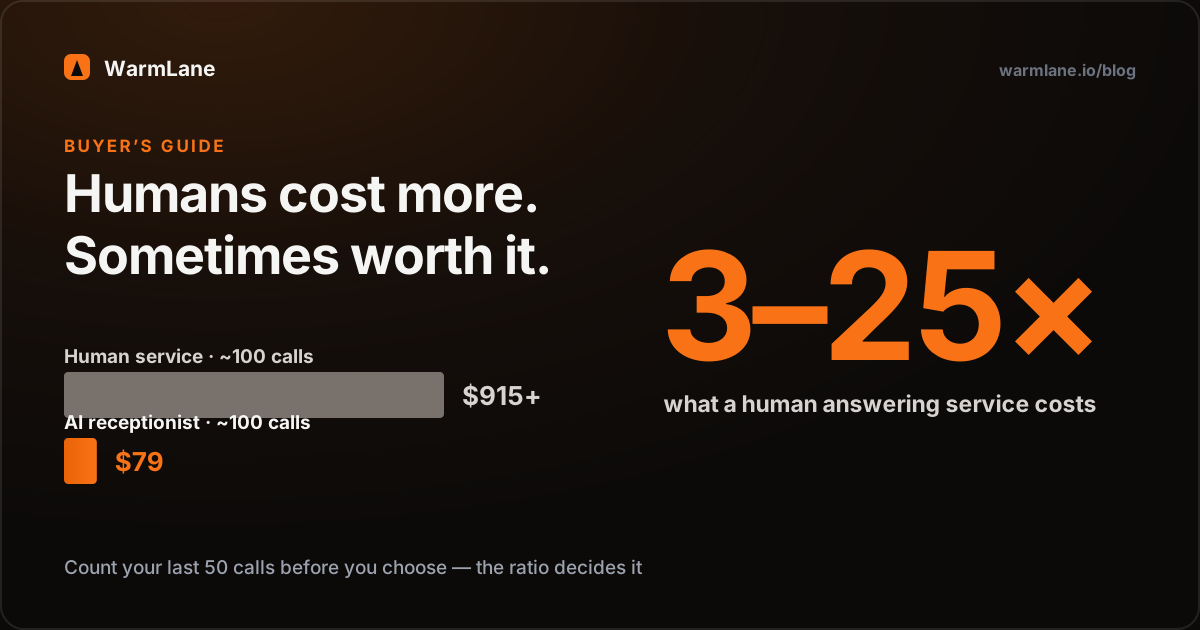
A human answering service puts a trained person on your calls. Ruby starts at $250/month for 50 minutes; Smith.ai at $300/month for 30 calls. An AI Sales Agent runs software: Warmlane $39.50/month (founding price for our first 50 customers, locked for life; list $79) with unlimited calls, Rosie from $49/month, Goodcall from $79/month per agent. Warmlane is strictly an AI Sales Agent: it answers every call, then qualifies the caller, handles the price question and books the job.
The cost gap runs from roughly 3× to 25× depending on volume. That gap is not one company overcharging - it is what employing people costs versus what running software costs, and the premium buys genuine judgement.
The deciding question is not "is AI as good as a person". It is what proportion of your calls actually require a person. For most trades, clinics and service businesses, 70–90% of inbound is booking, rescheduling, hours, service area and qualification - work with no human judgement in it. Paying human rates for that is the expensive mistake, not choosing AI.
Go human if your calls carry professional liability or emotional weight. Go AI if they are routine and your volume is spiky. Most businesses end up running both.
What each actually costs
| Service | Type | Entry | Included | Cost at ~100 calls/mo |
|---|---|---|---|---|
| Rosie | AI | $49/mo | 250 min | $149 |
| Warmlane | AI | $39.50/mo founding (list $79) | Unlimited | $39.50 |
| Goodcall | AI | $79/mo | 100 customers | $79 |
| Ruby | Human | $250/mo | 50 min | $1,725 |
| Smith.ai | Human | $300/mo | 30 calls | $915 |
| AnswerConnect | Human | Quote only | Not published | Not published |
Sources read 29 September 2026: Rosie, Goodcall, Ruby, Smith.ai, AnswerConnect, Warmlane at warmlane.io/pricing. The 100-call column is our own arithmetic assuming a three-minute average call: Rosie needs Scale ($149, and note booking is not on the $49 tier); Ruby needs Enterprise ($1,725 for 500 min); Smith.ai needs Basic $810 + 10 overage @ $10.50 = $915; Goodcall stays on Starter if those calls come from under 100 distinct people. Full breakdown in our pricing comparison.
At 100 calls a month, against a $79 AI plan, the gap is roughly 11× against Smith.ai and 22× against Ruby - and about double that at Warmlane's $39.50 founding price. Those multiples are large enough that the decision cannot sensibly be made on price - it has to be made on whether your calls need what the premium buys.
The test: read your own call log
Skip the vendor marketing entirely. Here is the only assessment that matters, and it takes about twenty minutes.
Pull your last 50 inbound calls - your phone bill, your mobile log, or your current answering service's records. Put each one in a bucket:
- Bucket A - routine. Are you open? Do you cover my area? Roughly what does X cost? Can I book Thursday? Can I move my appointment? Is my part in yet? Wrong number. Sales spam.
- Bucket B - judgement. Caller is distressed or angry. Situation doesn't fit any category. Needs assessing before it can be routed. Legally or clinically sensitive. High-value negotiation.
Then count. The ratio decides it:
| Your bucket B share | What that means | Recommendation |
|---|---|---|
| Under 10% | Almost all routine | AI Sales Agent |
| 10–30% | Mostly routine, some complex | AI with warm transfer to you |
| 30–60% | Genuinely mixed | Hybrid - AI on overflow, humans on daytime |
| Over 60% | Judgement is the job | Human answering service |
This framework is our own, offered as a practical heuristic rather than research. It is deliberately simple because the alternative - comparing vendor feature matrices - reliably produces worse decisions than counting your own calls. Run it on your real log, not on your impression of your calls; owners routinely over-estimate their bucket B share because difficult calls are the memorable ones.
That last point is worth repeating. Almost everyone guesses their bucket B share too high. Difficult calls stick in your memory; the forty calls asking whether you're open on Saturday do not. Counting them is the whole point of the exercise.
What only a human can do
We sell an AI Sales Agent and we are still going to be straight about this, because getting it wrong costs you more than a subscription.
Recognise an emergency that isn't described as one. A caller saying "there's a bit of water under the sink, no rush" may be describing a burst pipe. A patient describing vague chest discomfort may need triage now. A trained person hears the thing behind the words. AI improves at this yearly and is still not there.
Handle a caller who is upset. Genuine de-escalation - reading tone, slowing down, knowing when to stop following the script - is human work. An AI agent handling an angry customer badly can cost you more than the missed call would have.
Exercise professional judgement. Legal conflict checks, clinical triage, safeguarding disclosures, anything where a misjudged first conversation carries liability beyond a lost booking.
Represent a brand where the voice is the product. Private wealth management, high-end professional services, luxury hospitality. If a client discovering they spoke to software would draw an unflattering conclusion about the rest of your service, that is a real cost and no feature list offsets it.
Do outbound work. Chasing leads, following up quotes, confirming appointments proactively. Most AI Sales Agents are inbound-focused, ours included; Smith.ai's staffed model covers this.
What only AI can do
The reverse list is shorter but it matters more often than people expect, because these are structural advantages rather than quality ones.
Answer every call, simultaneously. A human service has staffing limits. When four people call at once during a storm or after an ad runs, three of them wait or go to voicemail. An AI agent answers all four instantly. This is the single biggest practical difference and it never appears on a feature comparison.
Cost nothing extra when you're busy. On per-call or per-minute pricing your best months are your most expensive. On flat-rate AI, a call spike is free. That inverts the relationship between success and cost.
Never have a bad day. No sick leave, no turnover, no Monday morning, no training a replacement. Consistency is genuinely a feature.
Cover 3am without a night shift. Human 24/7 coverage exists but it is priced accordingly. AI after-hours costs the same as AI at noon.
Give you the data. Every call transcribed, analysed for purpose and sentiment, scored for quality, searchable and exportable. Most answering services give you a message; a good AI Sales Agent gives you a corpus of what your market actually asks.
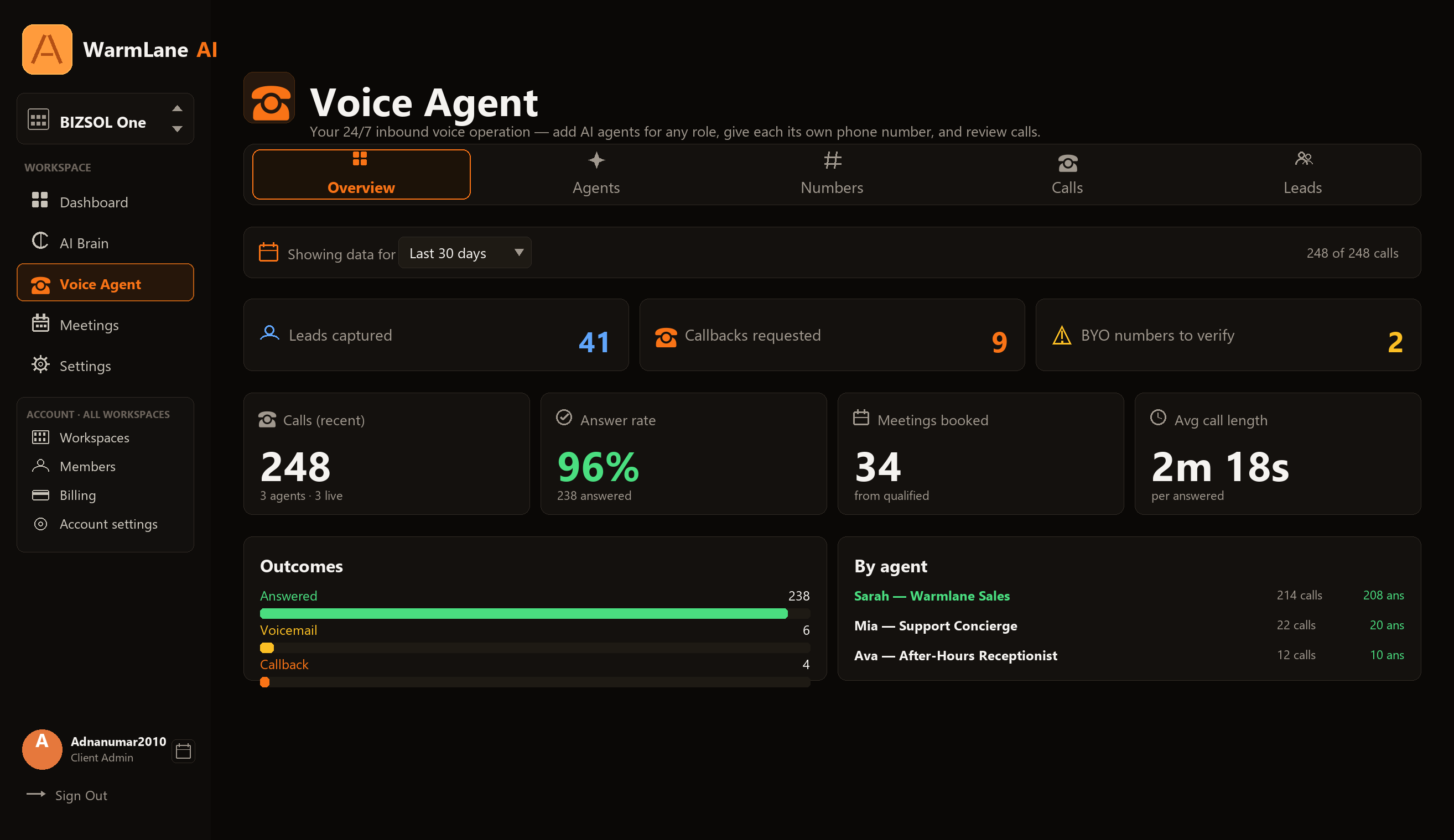
Twenty minutes with your call log, then five minutes with ours.
Count your bucket B share first. Then call our live agent and ask it the ten most common questions from bucket A. If it handles them, you have your answer - and it costs nothing to find out.
+1 (218) 683-6315This is our production agent, not a demo reel.
By industry
| Industry | Typical call mix | Usually better |
|---|---|---|
| Plumbing, HVAC, electrical | Short, routine, weather-spiky | AI |
| Dental, med spa, salon | Booking and rescheduling | AI |
| Veterinary | Booking, plus genuine emergencies | Hybrid |
| Real estate | Speed-to-lead, qualification | AI |
| General medical practice | Booking plus symptom triage | Hybrid |
| Law firms | Intake, conflict checks, distress | Human |
| Wealth & financial advisory | High value, brand-sensitive | Human |
| Trades with emergency lines | Routine plus urgent | Hybrid |
Our own assessment based on typical call mix per sector, not vendor claims or survey data. Treat it as a starting point and override it with your own bucket count - a dental practice doing complex surgical consults has a different mix from one doing hygiene appointments, and the log always beats the category.
If you would rather hear the "AI" rows than take our word for them, two dramatized examples: hear a 50-second sample HVAC call - a burst pipe at 11:48 PM, booked before midnight → and hear a 50-second sample real estate call - a buyer rings your sign on Sunday night, qualified and booked for a showing →
Note that law firms appear in the human column, consistently across everything we publish. Legal intake involves conflict checks, matter assessment and often distressed callers, and misreading any of those has consequences well beyond a lost booking. We would rather say that plainly than sell into a poor fit.
The hybrid most businesses land on
The most common real-world outcome is not a replacement. It is a split, and it usually looks like this:
- AI takes the volume and the hours. Every call answered instantly, any time, with no meter - booking, rescheduling, hours, service area, qualification, pricing questions, spam filtering.
- Humans take the exceptions. When a conversation genuinely needs judgement, the agent warm-transfers with context, or captures the details and flags it for immediate callback.
- The metered service shrinks. This typically removes 70–90% of inbound minutes or calls from a per-minute or per-call plan, which either drops you several rungs down the ladder or removes the need for it.
The reason this works is that the two failure modes are complementary. A human service fails on capacity and cost; AI fails on judgement. Routing by call type rather than choosing one supplier for everything addresses both.
If you want to test it without committing, point after-hours and overflow only at an AI agent first. That is where the alternative is voicemail, so the downside of an imperfect call is close to zero and the upside is every 9pm caller you were previously losing.