Blog › Buyer's guide
AI Sales Agent vs voicemail: measure your own number, not ours
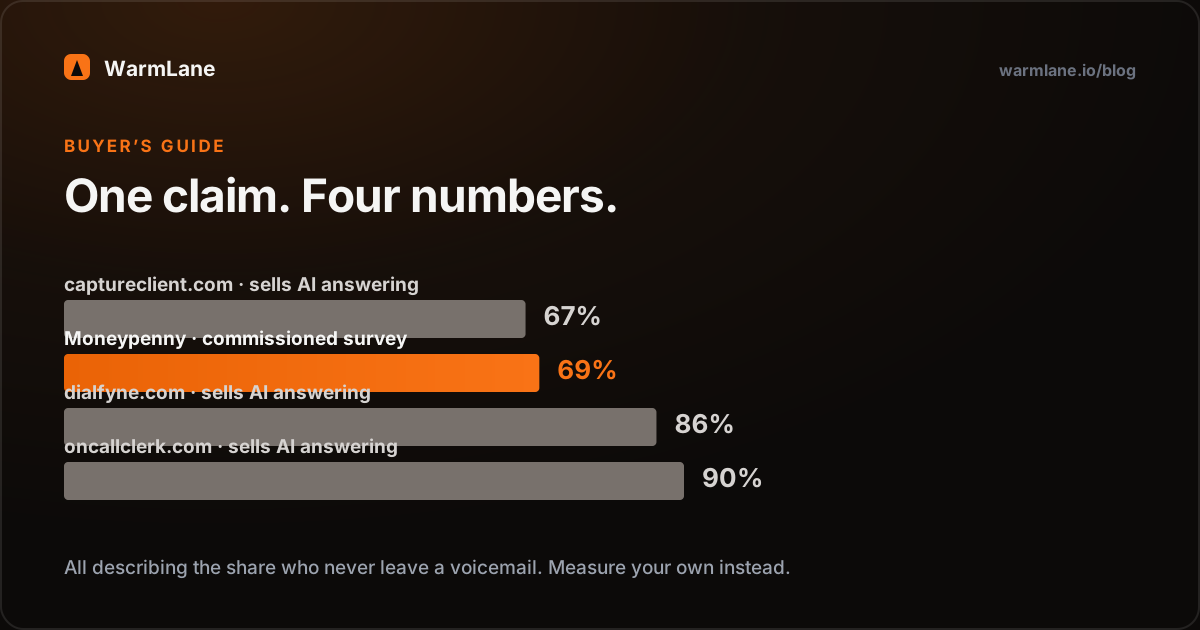
You have probably read that 62% of small business calls go unanswered, that businesses lose $126,000 a year to missed calls, or that 90% of callers never leave a voicemail. Treat all of those numbers with suspicion. Nearly every one traces back to a company selling AI answering services, and they contradict each other badly - the "never leave voicemail" figure alone appears as 67%, 69%, 86% and 90% depending on which vendor you read.
The two claims with genuine provenance are a Moneypenny-commissioned survey (69% of callers don't leave a voicemail) and older BIA/Kelsey research (67%). Moneypenny sells answering services too, but it commissioned real research and described its methodology, which is more than most.
The honest position: a large majority of callers who reach voicemail hang up, and nobody has a reliable universal number. Your own rate is knowable and takes about twenty minutes to work out from your phone bill. That number is worth more than every statistic on the internet, and this page shows you how to get it.
Who publishes the statistics
We went looking for a defensible figure to open this page with. What we found instead is worth showing you, because it tells you something about the whole category.
| Claim | Published by | What they sell |
|---|---|---|
| "62% of business calls go unanswered" | getaira.io | AI answering |
| "$126,000 lost per year" | skipcalls.com | AI answering |
| "90% of callers don't leave voicemail" | oncallclerk.com | AI answering |
| "86% hang up without leaving a message" | dialfyne.com | AI answering |
| "67% of callers never leave a voicemail" | captureclient.com | AI answering |
| "85% never call back, 62% call a competitor" | Multiple vendor blogs | AI answering |
| "69% of callers don't leave a voicemail" | Moneypenny | Answering service - but commissioned original research |
Compiled 29 September 2026 from a search of the most prominent published sources for missed-call statistics. Categorisation of what each publisher sells is our own, based on their websites. We are not alleging fabrication - several of these may be accurate. The point is that a statistic justifying a purchase, published by the company selling that purchase, with no primary source and no methodology, is not evidence. And Warmlane sells AI answering too - an AI Sales Agent that answers every call, then qualifies the caller, handles the price question and books the job - which is exactly why this page does not give you a number of its own.
Three specific problems with the circulating figures:
They contradict each other. The same claim - callers who reach voicemail and hang up - appears as 67%, 69%, 75–90%, 86% and 90%. Those cannot all be right. A spread that wide means the underlying measurements are either different populations, different definitions, or not measurements at all.
The big money figures have no visible primary source. "$126,000 per year" is repeated across many vendor sites without a study, sample size or method attached. A number that specific with no provenance is a marketing artefact, not a finding.
Circular citation. Vendor A cites vendor B, who cites vendor C, who cites a since-deleted blog post. Following these chains usually terminates in nothing, which is a recognisable pattern in any industry where a scary statistic sells a product.
What's actually sourceable
Being fair, some of it holds up better than the rest.
Moneypenny's commissioned survey is the strongest of what we found: an independent survey covering 300 micro businesses (0–9 employees) alongside call data from 10,000 businesses, reporting that 69% of callers don't leave a voicemail. Moneypenny is an answering service company, so the conflict is real - but they paid for original research and described the sample, which puts them ahead of everyone repeating a number they found elsewhere.
BIA/Kelsey (BIA Advisory Services) is a genuine research firm and the source of the widely-cited 67% figure. The citation is second-hand and dated in most places it appears, so treat the number as directionally useful rather than current.
A 2024 411 Locals study is cited for a breakdown of 37.8% of calls answered live, 37.8% to voicemail and 24.3% no response at all. We have not verified the primary document, so treat it accordingly.
A large majority of callers who reach voicemail do not leave a message. Every credible-looking source agrees on the direction even though none agree on the magnitude. Beyond that - the exact percentage, the dollar figure, the competitor-switching rate - nobody publishing on the open internet has shown their working, so we are not going to repeat their numbers as though they were facts.
Measure your own rate in 20 minutes
Here is the thing the statistics distract from: your own number is knowable, and it is the only one that should influence your decision.
Step 1 - pull the raw call data
- Business VoIP (RingCentral, 8x8, Dialpad, Grasshopper): the admin portal has a call log with answered, missed and voicemail counts. Export last month.
- Mobile: your call log shows missed calls. Tedious but workable - count a representative month.
- Landline: your carrier's online account usually shows inbound call records. If not, ask them for a call detail report - you are entitled to it.
- Google Business Profile: if calls come through a listed number, the performance report shows call volume by day and hour.
Step 2 - fill in four numbers
| Metric | Where it comes from | Yours |
|---|---|---|
| A · Total inbound calls last month | Call log | ______ |
| B · Calls answered by a person | Call log | ______ |
| C · Calls missed (A − B) | Calculate | ______ |
| D · Voicemails actually left | Voicemail box | ______ |
Now you have two figures nobody on the internet can give you:
- Your missed-call rate = C ÷ A
- Your voicemail abandonment rate = 1 − (D ÷ C)
Do this before you talk to any vendor, including us. If your missed-call rate is 4%, no answering solution is worth buying and anyone telling you otherwise is selling. If it is 40%, you have a problem worth solving and now you know its size.
Step 3 - check when the misses happen
Sort the missed calls by hour and day. Most businesses find a pattern: a cluster after 5pm, a cluster at weekends, and a cluster during their busiest working hours when everyone was already on the phone. That pattern tells you what you actually need - after-hours cover, overflow capacity, or both. It also tells you whether a capped plan would help or would run out precisely when you need it.
Work out what it's costing you
Rather than quote you a $126,000 figure, here is the arithmetic with your own inputs. It takes four numbers you already know.
| Input | Example | Yours |
|---|---|---|
| C · Missed calls per month | 40 | ______ |
| E · Share that were genuine new enquiries | 50% | ______ |
| F · Your close rate on enquiries you do reach | 30% | ______ |
| G · Your average job or client value | $400 | ______ |
| Monthly exposure = C × E × F × G | $2,400 | ______ |
The example figures are illustrative placeholders chosen to show the arithmetic, not research findings or claims about any real business. Your own inputs are the only ones that mean anything. Note this is a deliberately conservative model: it assumes a missed caller is worth the same as a reached one and ignores repeat business and referrals, which cuts both ways - it also ignores that some missed callers ring back.
Run it honestly and one of two things happens. Either the number is small, in which case you have saved yourself a subscription. Or it is several times the cost of any solution on our pricing comparison, in which case the decision makes itself without anyone needing to frighten you with a statistic.
Voicemail, forwarding, or AI
Once you know your numbers, the options are straightforward.
| Voicemail | Forward to mobile | AI Sales Agent | |
|---|---|---|---|
| Monthly cost | Free | Free | $39.50–$149 |
| Caller reaches something | A recording | You, if free | An agent, always |
| Works at 9pm / weekends | Records only | Interrupts you | Yes |
| Handles 3 callers at once | Records all | No | Yes |
| Books the appointment | No | If you're free | Yes |
| Answers questions | No | Yes | Yes |
| Filters spam calls | No | No | Yes |
| Interrupts your work | Never | Constantly | Never |
| Written record of the call | Audio only | None | Full transcript |
Our own comparison of the three approaches. AI Sales Agent pricing from our verified pricing table, read from vendor pages 29 September 2026.
The under-discussed column is the middle one. Call forwarding to your mobile is not free - it just moves the cost off your invoice and onto your attention. Every call arrives while you are under a sink, with a patient, driving, or at dinner. You answer badly, or you do not answer, and the caller reaches your personal voicemail instead of your business one. Many people who think they have solved this with forwarding have actually just relocated the problem.
The genuine argument for an AI Sales Agent over voicemail is not a scary statistic. It is structural: voicemail's answer to every caller is "leave a message and wait", and an AI agent's answer is "here's an appointment on Thursday at 2". One of those is a transaction and the other is a request for one.
Do the maths first. Then call ours.
Work out your own missed-call rate and exposure before you shortlist anything. If the number justifies it, hear what a caller would actually get - this is our live production agent, the same live agent you'd deploy on your own line.
+1 (218) 683-6315If your missed-call rate turns out to be tiny, don't buy anything. Including from us. If it doesn't: 14-day free trial, no card. Founding price $39.50/mo, locked for life for our first 50 customers.