Blog › Industry guide
Best AI Sales Agent for plumbers, HVAC and home services
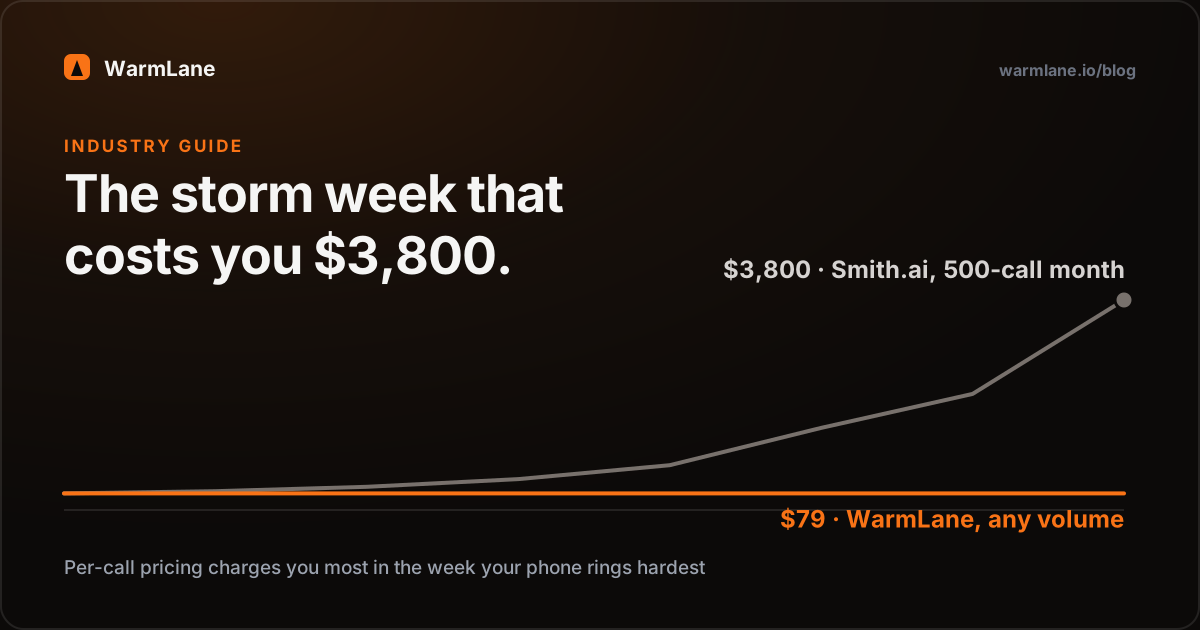
Home services inbound has three properties that decide this choice: calls are short (mostly availability, service area, rough pricing, booking), routine (little human judgement required), and violently spiky (a cold snap or a storm can triple your week).
That third property is the one that matters. Per-call and per-minute pricing makes your busiest week your most expensive week - a 500-call storm month on Smith.ai's Pro plan runs about $3,800, against $39.50–$79 on a flat-rate AI agent. Metered plans also run out precisely when the phone is ringing hardest.
For most trades the shortlist is flat-rate AI: Warmlane at $39.50/month (founding price for our first 50 customers, locked for life; list $79) with unlimited calls, or Goodcall at $79/month per agent if your unique caller count stays under 100. Rosie at $49/month works if you only need messages taken, but booking starts at its $149 tier. Warmlane is an AI Sales Agent rather than a message-taker: it answers every call, then qualifies the job, handles the "how much?" question and books it onto your calendar.
The one thing to get right regardless of vendor is emergency handling - a caller saying "there's a bit of water under the sink" may be describing a burst pipe. Make sure whatever you buy escalates properly.
Why trade calls are different
Generic answering-service advice is written for offices. Trades are not offices, and four things about your call pattern change the maths completely.
You physically cannot answer. You are under a sink, on a roof, in a crawl space, in an attic, or driving between jobs with your hands full. This is not a scheduling problem you can fix with discipline - the job and the phone are mutually exclusive. Office businesses have someone at a desk; you do not.
Your calls are short and repetitive. "Do you cover Northgate?" "How much for a boiler service, roughly?" "Can someone come Thursday?" "Are you open Saturday?" "My appointment's at 2, can we move it?" Most of your inbound is answerable from a page of facts about your business. There is no judgement in it, which is precisely why paying human receptionist rates for it is poor value.
Volume is weather-driven and unpredictable. First hard freeze, first heatwave, a storm, a burst-main incident locally - and your call volume triples for a week. These are your highest-revenue weeks. Any pricing model that charges more when you are busier is working directly against you.
Speed decides who wins the job. A homeowner with water coming through a ceiling is not leaving a voicemail and waiting. They are working down the search results until somebody picks up. Being second to answer is the same as not being listed.
The storm-week test
Here is the comparison that actually matters for a trade business: a normal month next to the month you most want to get right.
| Service | Quiet month 60 calls |
Normal month 150 calls |
Storm month 500 calls |
|---|---|---|---|
| Warmlane | $39.50 | $39.50 | $39.50 |
| Goodcall | $79 | $79–$104* | $249–$399* |
| Rosie (with booking) | $149 | $149 | $299+ |
| Ruby | $720 | Above tiers | Above tiers |
| Smith.ai | $810 | $1,485 | $3,800 |
Our own arithmetic from vendor pricing read 29 September 2026 (Goodcall, Rosie, Ruby, Smith.ai), assuming a three-minute average call and taking the cheapest plan covering each volume. Smith.ai: 60 → Basic $810; 150 → Basic + 60 overage @ $10.50 = $1,440; 500 → Pro $2,100 + 200 @ $8.50 = $3,800. Ruby: 60 calls ≈ 180 min → Business $720; higher volumes exceed Ruby's published 500-minute ceiling. Rosie: 500 calls ≈ 1,500 min, exceeding Scale's 1,000-minute allowance, so Growth at $299 or above - Rosie does not publish a minutes overage rate. *Goodcall meters unique customers, not calls, so your figure depends on your repeat-caller ratio; a storm month is mostly new callers, which pushes you up its tiers. Warmlane is bring-your-own-Twilio and OpenAI, billed to you directly at cost. Warmlane figures are the founding price for our first 50 customers, locked for life (list $79).
Read the right-hand column again. On Smith.ai, the week your phone rang hardest produces a $3,800 invoice. On a flat-rate agent, it produces the same flat fee as January - and every one of those 500 callers got answered instead of hitting a capped plan or a voicemail box.
That is the entire argument for flat-rate pricing in a weather-driven trade, and it is not really about being cheap. It is about your cost structure not punishing you for a good week.
"What does my bill look like in a month where I take three times my normal call volume?" If the answer is a bigger number, that vendor's incentives are misaligned with a seasonal trade. Ask it before you sign, not after your first cold snap.
Which service to choose
| Warmlane | Goodcall | Rosie | Smith.ai | Ruby | |
|---|---|---|---|---|---|
| Entry price | $39.50 (founding; list $79) | $79 | $49 | $300 | $250 |
| Cost in a spike month | Unchanged | Rises | Rises | Rises sharply | Rises sharply |
| Books the job on the call | Yes | Yes | $149 tier | Yes | Yes |
| Answers 4 callers at once | Yes | Yes | Yes | Staffing | Staffing |
| After-hours at no extra cost | Yes | Yes | Uses minutes | Uses calls | Uses minutes |
| Escalates a real emergency | Warm transfer | Flow-dependent | Scale tier | Human judgement | Human judgement |
| Knows your service area | AI Brain | You configure | You configure | Briefed | Briefed |
| Call history kept | Full | 7 days | Yes | Yes | Yes |
| Who sets it up | We do, free | You do | You do | They do | They do |
Compiled 29 September 2026 from vendor pricing pages linked above and in our full pricing comparison. "Staffing" means capacity depends on how many receptionists are available, an inherent property of human services. "Flow-dependent" means the behaviour depends on logic flows you build yourself. Goodcall's 7-day figure is call and customer detail retention on its Starter plan; 30 days on Growth, unlimited on Scale.
Flat-rate AI, and mostly for structural reasons rather than because we sell one. Your calls are routine enough that AI handles them, your volume is spiky enough that metering hurts, and your margins do not support $800–$3,800 months for answering the phone. If you run a business where most calls are genuine emergencies requiring judgement - some 24-hour restoration and emergency-only operations do - a human service is defensible.
Ring it like a customer with a leak would.
Ask if it covers your area. Ask what a callout costs. Say your boiler's making a noise. Ask for someone Thursday morning. This is our live production agent - the same live agent you'd put on your own van.
+1 (218) 683-6315Live within a day. We build it - you keep working.
Emergency triage - get this right
This is the part of a trade deployment that deserves the most attention, and the part most vendors gloss over.
Homeowners routinely under-describe emergencies. "There's a bit of water under the sink." "The boiler's making a funny noise." "It's not urgent but the heating's off." Any of those can be a burst pipe, a carbon monoxide risk, or a vulnerable household with no heat in December. A receptionist - human or AI - that files all three as "book next available" is creating a real problem, not solving one.
What a properly configured agent should do:
- Ask the escalating questions. Is water actively flowing? Can you reach the stopcock? Is there a smell of gas? Is anyone in the property elderly, very young or unwell? Is there heat at all?
- Have an explicit emergency branch that overrides normal booking - same-day dispatch, or immediate warm transfer to you or your on-call engineer regardless of hour.
- State the safety instruction where appropriate - turn off the stopcock, do not switch anything electrical on, leave the property and call the gas emergency line - before it does anything else.
- Never leave the caller stranded. If it cannot handle the situation, it transfers or takes details and flags immediately. Trapping a panicking customer in a booking flow is worse than voicemail.
With Warmlane this is part of what our team builds for you at no cost - we write the emergency branch and the escalation rules into your agent as part of Done-For-You setup, because leaving a plumbing firm to configure that themselves is how it ends up not being configured. On self-service tools you will need to build it yourself, so budget the time and test it properly before going live.
And be honest with yourself about the mix. If genuine emergencies are the majority of your inbound rather than a minority branch, a human service with real judgement is the safer purchase, and we would tell you that on a sales call.
Want to hear what that emergency branch sounds like in practice? Hear a 50-second sample HVAC call: a burst pipe at 11:48 PM, booked before midnight → It is a dramatized example with a fictional business and caller, so you can hear the triage questions and the booking without waiting for a real leak.
Service area and job qualification
The second trade-specific job is filtering. A large share of trade inbound is people you cannot or should not serve, and every one you qualify out on the call is a callout you did not waste.
- Outside your service area. The agent should know your radius or postcode list and say so immediately, rather than booking a job forty miles away that you then have to cancel.
- Work you don't do. Commercial when you are domestic-only, gas when you are not certified, a brand you do not service.
- Price-shopping with no intent. Not worth a callout slot. A good agent gives your indicative pricing and lets them self-select.
- Spam and sales calls. Filtered before they ever reach you.
- Landlord vs tenant vs homeowner. Who is authorising the work and who is paying - worth establishing before dispatch, not on the doorstep.
This is where an agent grounded in your actual business details earns its money, and it is why a generic script underperforms. Your service area, your certifications, your callout charge, your brands, your out-of-hours rate - an agent that knows all of it books better jobs than one that just takes names.
The bilingual dispatch case
A meaningful share of home-services calls in California, Texas, Florida, Arizona and much of the Southwest come in Spanish. The typical situation: the dispatcher speaks English, the caller speaks Spanish, and the current fix is a friend or family member relaying details a sentence at a time - which is slow, error-prone, and gets abandoned when the call is time-critical (a leak, no heat in a cold snap, an AC out in a heatwave). If you don't have a bilingual dispatcher on shift, those calls either go to voicemail or to a competitor who does.
An AI Sales Agent that natively speaks Spanish removes that bottleneck. Warmlane's AI Sales Agent handles 29 languages - Spanish (US, Mexico, Spain), Portuguese (Brazil), plus 25 more - at the same flat $39.50/month (founding price for our first 50 customers, locked for life; list $79) with no per-character surcharge. On a Spanish call the greeting, the caller's transcript, and the AI's response all run in Spanish end-to-end; when the situation genuinely needs your dispatcher, the agent warm-transfers to you. The full technical picture is in our multilingual AI Sales Agent deep-dive. Standard setup for a bilingual trade: one English agent and one Spanish agent, each with its own inbound number, both booking into the same dispatch calendar.
What to check before you buy
- What happens in a triple-volume month? Get the number, not a reassurance.
- Is booking included at the tier you're quoted? Rosie's $49 plan cannot book - that catches people out.
- How many callers can it handle at once? During a freeze, four people ring in the same ten minutes. A human service has staffing limits; check the AI vendor's concurrency too.
- How does it handle an emergency? Ask for the specific escalation behaviour and test it during your trial.
- How long is call history kept? Goodcall's Starter plan keeps 7 days. When a customer disputes what they were quoted six weeks ago, that matters.
- Can it read your actual calendar? Offering real slots beats "someone will call you back" - that gap is where jobs get lost to whoever answers next.
- Can you keep your number? It is on your van, your website and every job sheet. It should not have to change.
- Who configures it? If the answer is you, be realistic about whether you will finish. Half-configured agents produce mediocre calls indefinitely.
Frequently asked questions
What's the best AI Sales Agent for a plumbing or HVAC business? +
How much does an answering service cost for contractors? +
Can an AI Sales Agent handle emergency calls? +
Will it know my service area and pricing? +
What happens when several customers call at the same time? +
Can I keep the number that's on my van? +
How long does it take to set up? +
$39.50/month founding price (list $79). Unlimited calls, including storm weeks.
We build it, you keep working. Hear it first.
+1 (218) 683-631514-day free trial, no card. Free Done-For-You setup and support included.