Blog › Industry guide
Best AI Sales Agent for dental practices and med spas
Clinics have a specific version of the missed-call problem: your front desk is not absent, it is occupied. Someone is checking a patient out, taking a payment, or handling a query at the desk while the phone rings - and the caller on the other end is often a new patient worth far more than the transaction in front of you.
For booking, rescheduling, hours, treatment questions, pricing and new-patient enquiries, an AI Sales Agent handles the work well and costs $39.50–$149/month against $250–$300+ for a human service. It answers during the appointment, after close, and at weekends, and it takes several simultaneous callers. Warmlane is an AI Sales Agent: it answers every call, then qualifies the new patient, handles the "how much is it?" question and books the consultation.
Two things to get right. First, clinical triage is a hard boundary - an agent should route symptom and post-operative calls to a person, never assess them. Second, ask every vendor directly about HIPAA and a signed BAA before you sign anything; do not assume, and do not accept a marketing page as an answer.
Med spas are the easier case - largely aesthetic bookings with little clinical risk. General dental and medical practices should run a hybrid with a clear human escalation path.
The occupied-front-desk problem
Most advice about missed calls assumes nobody is there. In a clinic, somebody almost always is - which makes the problem harder to see and easier to under-estimate.
Your receptionist is checking out a patient, processing a card, rebooking a six-month recall, answering a question about a treatment plan, or handling an insurance query that takes eleven minutes. The phone rings. They cannot pick it up without abandoning the person physically standing in front of them, and abandoning that person is also bad service. So it rings out, or a second line queues, or it goes to voicemail.
Three things make this particularly expensive in a clinic:
The caller is often a new patient. New-patient acquisition is the most valuable inbound event a practice has, and it arrives unannounced, mixed in with routine calls, at the moment your desk is busiest. A new patient who cannot reach you rings the practice down the road - they are not committed to you yet.
Your busiest phone hours are your busiest desk hours. Monday mornings, lunchtime, and the hour after close are peak for both. The problem is structurally self-reinforcing: the more patients you are seeing, the less able you are to answer the phone about seeing more.
The interruption cost is real too. A receptionist juggling a ringing phone and a patient at the desk does both worse. Taking routine calls off them is not only about the missed calls - it is about the quality of everything else they do.
What clinic calls actually are
Before choosing anything, categorise a week of your calls. In most practices the split looks roughly like this:
| Call type | Needs a clinician? | AI can handle |
|---|---|---|
| New patient enquiry + booking | No | Yes |
| Rescheduling or cancelling | No | Yes |
| Opening hours, location, parking | No | Yes |
| Treatment pricing, finance options | No | Yes |
| Do you take my insurance / plan? | No | Yes |
| Pre-appointment prep questions | Sometimes | Partly - escalate if unsure |
| Recall and reactivation follow-up | No | Outbound AI tools only (Warmlane answers inbound calls) |
| "Is this normal after my procedure?" | Yes | No - route to a person |
| Pain, swelling, bleeding, symptoms | Yes | No - route to a person |
| Medication questions | Yes | No - route to a person |
Our own categorisation, offered as a starting framework rather than clinical guidance. Every practice differs - an oral surgery list has a very different mix from a hygiene-led practice or an aesthetics clinic. Run the exercise on your own call log and adjust. Where a call type sits near the boundary, route it to a person; the cost of an unnecessary transfer is trivial next to the cost of a missed clinical concern.
The top block is usually the large majority of volume and contains no clinical judgement at all. That block is what an AI Sales Agent is for. The bottom block is a hard boundary and belongs to your team.
The after-hours booking case
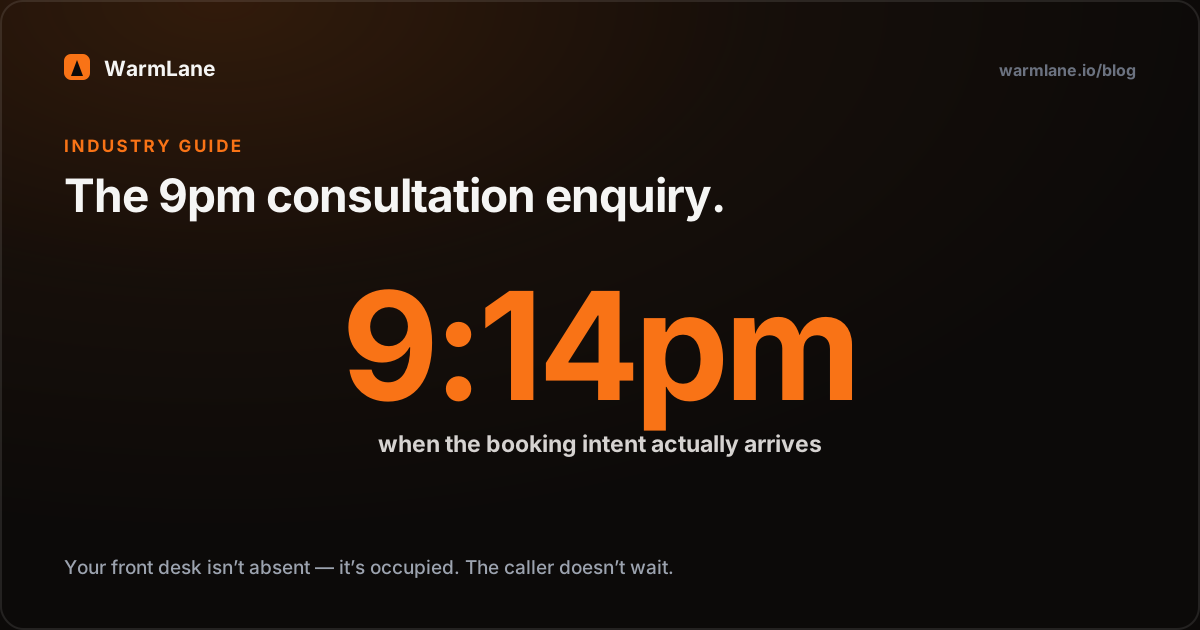
The argument that tends to land hardest with practice owners is not about cost. It is about when people actually decide to book.
Patients research treatment in the evening. They think about a chipped tooth, or finally book the consultation they have been putting off for eight months, at 9pm on a Sunday after scrolling through your before-and-afters. That impulse has a short half-life. If it reaches a voicemail greeting, a meaningful share of it evaporates by Monday.
This matters more for elective and aesthetic work than for routine dentistry, because elective bookings are motivated by a moment of intent rather than a fixed need. A med spa or cosmetic practice that only captures enquiries between 9 and 5 is systematically missing the hours when its market is most inclined to commit.
An AI agent answers at 9pm, discusses the treatment from your own information, and puts the appointment in your diary while the intent is still live. Nothing about that requires a clinician, and it is the single clearest win in this category.
For the aesthetics version of that moment: Hear a 45-second sample med spa call: the front desk is busy, and a first-time Botox client still gets a Saturday consult booked → It is a dramatized example with a fictional clinic and caller.
Call it the way a nervous new patient would.
Ask what a consultation costs. Ask if you take a particular plan. Ask what's involved. Then ask for something next Tuesday afternoon. This is our live production agent - the same live agent you'd put on your own practice line.
+1 (218) 683-6315Judge the tone as your patients would hear it.
The multilingual-patient case
Practices in Los Angeles, Miami, Houston, New York and much of Texas routinely field 15–30 percent of their new-patient calls in Spanish. Practices in Vancouver and Toronto see a similar mix in Mandarin. Practices near universities see a long tail of everything else. If your front desk is monolingual, a share of those calls silently drops off - the caller hears an English greeting they don't fully follow, thanks you, and calls the next clinic.
An AI Sales Agent that natively speaks the caller's language changes that number. Warmlane's AI Sales Agent covers 29 languages - English (US, UK, AU, India), Spanish (Spain, Mexico, US), French (France, Canada), German, Italian, Portuguese (Brazil, Portugal), Dutch, Polish, Russian, Turkish, Hindi, Arabic, Mandarin Chinese, Japanese, Korean and more - at the same flat $39.50/month (founding price for our first 50 customers, locked for life; list $79), with no per-character surcharge. The picked language runs end-to-end: greeting, speech-to-text transcription of the caller, and the AI's response are all in that language. See our multilingual AI Sales Agent deep-dive for the technical details. The standard pattern is one agent per language, each with its own inbound number. A high-volume Latino patient base is one of the strongest single-line ROI cases in this whole guide.
The clinical triage boundary
An AI Sales Agent should never assess symptoms, judge urgency of a clinical complaint, or advise on medication or post-operative concerns. Those calls go to a person. This is not a limitation to work around with better prompting - it is a boundary to design in deliberately.
Patients under-describe things. "It's a bit sore since Thursday" can be a normal healing response or a spreading infection. "I've had some bleeding" can be routine or urgent. A receptionist - human or AI - is not the right party to make that call, and an AI agent that confidently books a routine slot for something that needed same-day attention has created a clinical risk, not saved a phone call.
What a correctly configured clinic agent should do:
- Detect the category, not the severity. Recognise that the caller is describing a symptom or post-procedure concern, and stop there.
- Route immediately - warm transfer to your team during hours, or capture details and flag urgently out of hours, alongside your existing emergency instruction.
- Give the out-of-hours emergency guidance your practice already uses, verbatim, without improvising.
- Never speculate. No "that sounds normal", no "that can wait until Monday". Ever.
- Log it clearly so the clinical concern is visible in the morning, not buried in a list of booking requests.
With Warmlane this boundary is written into your agent as part of free Done-For-You setup - we configure the clinical escalation path with you rather than leaving you to discover the gap later. On self-service tools you must build it yourself, and it is the single most important thing to test before going live.
Practically: med spas and aesthetic clinics have a smaller clinical surface and are the straightforward case. General dental and medical practices should run AI for booking and administration with a firm, tested human escalation path - a hybrid, not a replacement.
HIPAA, BAAs and what to ask
We are going to be direct here rather than reassuring, because this is where vendors are vaguest and the consequences of getting it wrong are yours.
Do not assume any AI Sales Agent is HIPAA compliant. Ask each vendor explicitly whether they will sign a Business Associate Agreement, and get the answer in writing before you route a single patient call.
Two data points worth knowing as you evaluate:
- Compliance is a real, separately-priced cost in this industry. Vapi lists a HIPAA add-on at $2,000/month on top of usage. That tells you compliance is not something a vendor absorbs quietly into a sub-$100 plan.
- Data retention varies enormously. Goodcall's Starter plan keeps call and customer details for 7 days; Vapi's pay-as-you-go tier keeps 14 (30 on its $29/month Core plan). Short retention may reduce exposure, but it also means the record of a patient interaction is gone when you need it.
On Warmlane specifically: we store text transcripts rather than audio recordings, which reduces the amount of identifiable material held, and you keep full call history rather than a rolling window. The agent collects only basic details - name, contact, reason for the call - and never asks for medical history. That is a description of how the product works - it is not a claim of HIPAA compliance. If your practice requires a signed BAA, email sales@warmlane.io and ask us directly before you sign up. We would rather tell you plainly what we can and cannot offer than have you infer it from a feature list.
Questions to put to every vendor on your shortlist, in writing:
- Will you sign a BAA? Under what plan and at what cost?
- Is audio stored, or only text? For how long, and where?
- Who at your company can access call content, and is that logged?
- Which sub-processors handle the data - speech recognition, LLM, telephony?
- Can we request deletion of a specific patient's records?
- What happens to our data if we cancel?
Which service to choose
| Warmlane | Goodcall | Rosie | Smith.ai | Ruby | |
|---|---|---|---|---|---|
| Entry price | $39.50 (founding; list $79) | $79 | $49 | $300 | $250 |
| Books appointments at entry tier | Yes | Yes | $149 tier | Yes | Yes |
| Answers while desk is busy | Yes | Yes | Yes | Yes | Yes |
| Several callers at once | Yes | Yes | Yes | Staffing | Staffing |
| Evening / weekend at no extra cost | Yes | Yes | Uses minutes | Uses calls | Uses minutes |
| Clinical judgement | No - escalates | No - escalates | No - escalates | Human | Human |
| Call history kept | Full | 7 days | Yes | Yes | Yes |
| Stores audio recordings | No - text only | Ask vendor | Ask vendor | Ask vendor | Ask vendor |
| Who configures it | We do, free | You do | You do | They do | They do |
Compiled 29 September 2026 from vendor pricing pages: Goodcall, Rosie, Smith.ai, Ruby, and Warmlane at warmlane.io/pricing. "Ask vendor" means we did not find a published statement on audio storage for that service - this is a question to put in writing rather than infer. "Staffing" reflects that human services are limited by receptionists on shift. None of the rows in this table constitute a HIPAA compliance claim for any vendor including Warmlane; see the section above.
Med spas and aesthetic clinics: flat-rate AI. Your call mix is overwhelmingly bookings, treatment questions and pricing, your highest-intent enquiries arrive in the evening, and the clinical surface is small. Dental and general medical practices: AI for booking, rescheduling, hours, insurance and new-patient enquiries, with a firm tested escalation to your team for anything clinical. Practices where triage dominates inbound: a human service, or at minimum keep human coverage in hours.
Frequently asked questions
Is an AI Sales Agent HIPAA compliant? +
Can an AI Sales Agent handle patient symptom calls? +
What's the best AI Sales Agent for a dental practice? +
Will patients mind speaking to an AI? +
Can it answer insurance and treatment pricing questions? +
Can it reduce no-shows? +
How much does it cost compared with a human answering service? +
Can it work alongside my existing front desk rather than replacing them? +
Answer the 9pm consultation enquiry.
$39.50/month founding price (list $79), unlimited calls, booking included, built for your practice at no extra cost.
+1 (218) 683-631514-day free trial, no card. Ask us about BAAs before you sign up.