Blog › Guides
Missed Call Cost Calculator: What Unanswered Calls Cost Your Business
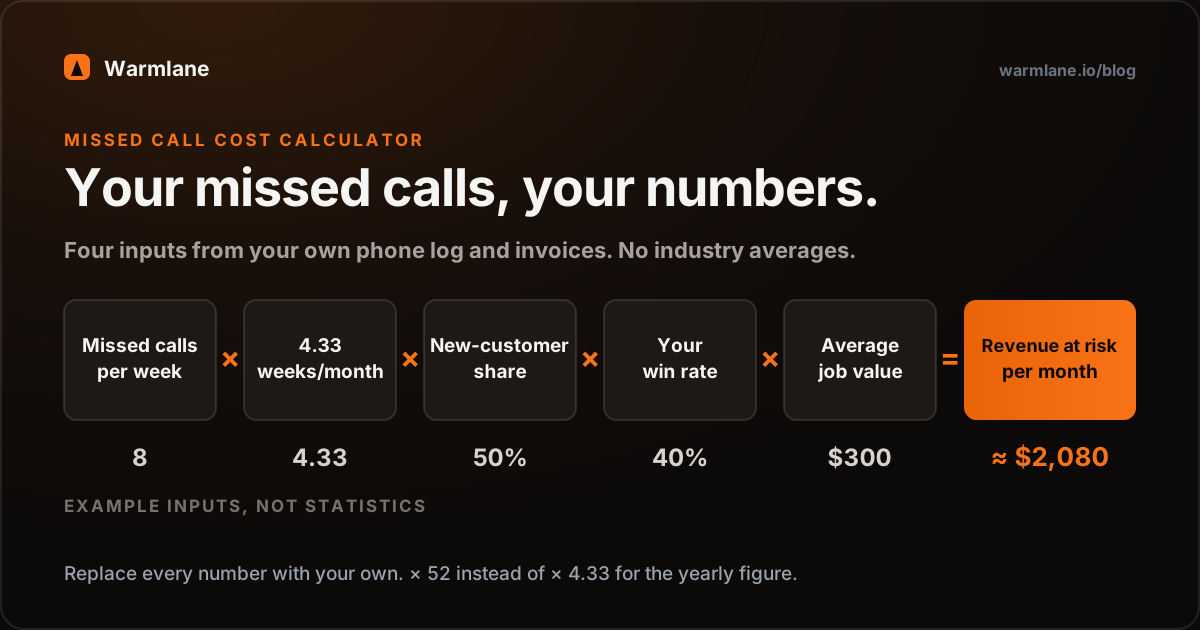
What missed calls cost your business depends on four numbers only you can know: how many calls you miss each week, what share of them are new customers, how often you win a new customer you do reach, and your average job value. Multiply them: missed calls per week × 4.33 × new-customer share × win rate × average job value = revenue at risk per month.
The calculator below does the arithmetic. Every input can be pulled from your own phone log and job records in under an hour. Ignore any headline figure that claims to know your answer without asking for these four numbers.
The missed call cost calculator
Replace the example values with your own. Results update as you type.
Prefer sliders? There's a quicker version on our home page calculator.
The formula, explained
Revenue at risk from missed calls is the number of missed calls that were real new-customer opportunities, multiplied by the share you would have won, multiplied by what a job is worth.
| Step | What it means | Example input | Running total |
|---|---|---|---|
| Missed calls per week | Calls nobody answered | 8 | 8 a week |
| × 4.33 | Weeks in an average month (52 ÷ 12) | 4.33 | ≈ 34.7 a month |
| × New-customer share | Calls that were potential new work | 50% | ≈ 17.3 opportunities |
| × Win rate | How often you'd book them | 40% | ≈ 6.9 jobs |
| × Average job value | Revenue per first job | $300 | ≈ $2,080 a month |
Example inputs are illustrative placeholders chosen to show the arithmetic. They are not research findings and don't describe any real business. Your own numbers are the only ones that mean anything.
How to find each number from your own records
Set aside an hour with your phone, your calendar and your invoices. Use the last four weeks; if your work is seasonal, do it once for a busy month and once for a quiet one.
1. Calls you miss per week
- Business VoIP or phone app (RingCentral, Grasshopper, Dialpad and similar): the admin call log shows answered and missed calls. Filter to the last 28 days.
- Cell phone: scroll your recent calls and count the missed ones. Tedious, but 20 minutes gets you a real number.
- Landline: your carrier's online account usually lists inbound calls; if not, ask for a call detail report.
Count unique numbers, not attempts: someone who called three times in ten minutes is one missed opportunity. Divide the four-week total by 4.
2. Share that are new-customer opportunities
Go through those missed numbers. Remove anything in your contacts (existing customers, suppliers, family), obvious spam and robocalls, and sales calls. Look up unknown numbers if you need to. What's left, divided by the total, is your new-customer share. If you can't tell, be conservative and count it as not an opportunity.
3. Share you'd normally win
This comes from the calls you did answer. Take last month's answered calls from new customers and count how many turned into a booked job. Jobs booked ÷ new-customer calls answered = your win rate. Your calendar and invoices are the source. Don't use the number you hope for; use the one in the records.
4. Average job value
Add up invoices for first jobs with new customers last quarter and divide by how many there were. Use the first job, not lifetime value. That keeps the answer conservative; if a typical customer comes back for years, the real cost of losing them is higher than the calculator shows.
Got a number worth fixing? Hear what callers would get instead.
Call our live demo agent like one of your missed callers would: ask about your area, ask for a price, ask for a time. It answers, qualifies and books.
+1 (218) 683-631514-day free trial, no card. Founding price $39.50/mo, locked for life for our first 50 customers. Free done-for-you setup.
Why we don't use "X% never call back" figures
Search "cost of missed calls" and you'll find confident numbers: a precise percentage of callers who never call back, a share who go straight to a competitor, a five- or six-figure annual loss. Most of them are published by companies that sell call answering. We sell call answering too, which is exactly why we don't repeat them.
When we traced the common figures for our AI Sales Agent vs voicemail guide, three problems kept showing up:
- They contradict each other. The same claim appears with very different percentages on different sites. They can't all be right.
- No visible method. The big dollar figures rarely come with a study, a sample size or a date.
- Circular citation. Site A cites site B, which cites site C, which cites nothing you can find.
What does hold up: most callers who reach voicemail don't leave a message. Every credible source agrees on the direction, even though they disagree on the size. Beyond that, an industry average wouldn't help you anyway. A roofer with $12,000 jobs and an auto shop with $250 oil-change customers have nothing in common, which is why this calculator asks for your numbers instead.
What this calculator doesn't tell you
Be honest with the result. This is revenue at risk, not revenue any product will recover.
- Some missed callers call back. The model doesn't subtract them, so it can overstate the loss if callers in your trade tend to try again.
- A missed caller isn't always as likely to buy as one you reach. Some were just price shopping.
- No answering method wins every call. Answering fast gives you the chance to win the job; it doesn't guarantee it.
- It ignores repeat business and referrals, which pushes the other way and makes the result conservative.
- It's revenue, not profit. If you want profit, multiply by your margin.
What to do with your number
If it's small (say, less than one job a month): don't buy anything. Improve your voicemail greeting, set up call forwarding, and turn on missed-call text-back. Our guide to answering calls while you're on a job covers the free fixes.
If it's a few jobs a month or more: compare it with what each option costs. A human answering service starts at a few hundred dollars a month and is metered. Missed-call text-back is cheap but only starts a conversation (text-back vs AI Sales Agent explains the difference).
Warmlane is an AI Sales Agent: it answers every call, then qualifies the caller, handles the price question and books the job. It answers every call 24/7, quotes your own prices, books onto Google Calendar or Calendly with text and email confirmations, notifies you, and calls back and texts missed or dropped callers. It costs $39.50/month for our first 50 founding customers, locked for life (list $79), plus your own Twilio and OpenAI usage at cost, roughly $15–20 a month at 100 calls. See pricing, or hear a 50-second sample call for a plumbing business.
Test it against your own number. Day 1, start free with no card; we build the agent for you and it's usually live within a day. Days 1 to 14, it answers your calls, and you can count the jobs it books against your calculator result. Day 15, add a card to keep going, or the account pauses; nothing is charged and nothing is deleted.
Your calculator result is under the monthly cost. You need payments or deposits taken on the call, or jobs written straight into Jobber, Housecall Pro or ServiceTitan (Warmlane books to Google Calendar or Calendly and exports leads as CSV). Or most of your calls are genuine emergencies that need human judgment; Warmlane isn't an emergency service.
Frequently asked questions
How do I calculate the cost of missed calls? +
How much do missed calls cost a small business? +
Are the default numbers in the calculator industry averages? +
Is it true that most callers never call back? +
How many jobs would it take to pay for Warmlane? +
Does this calculator show how much an AI Sales Agent will recover? +
Where do I find how many calls I miss? +
Put your number to the test for 14 days.
We build your AI Sales Agent free, usually live within a day. Count the jobs it books, then decide.
+1 (218) 683-631514-day free trial, no card. Founding price $39.50/mo, locked for life for our first 50 customers. Free done-for-you setup.