Blog › Trades
Answering Service for Roofers, Electricians & Garage-Door Companies (2026)
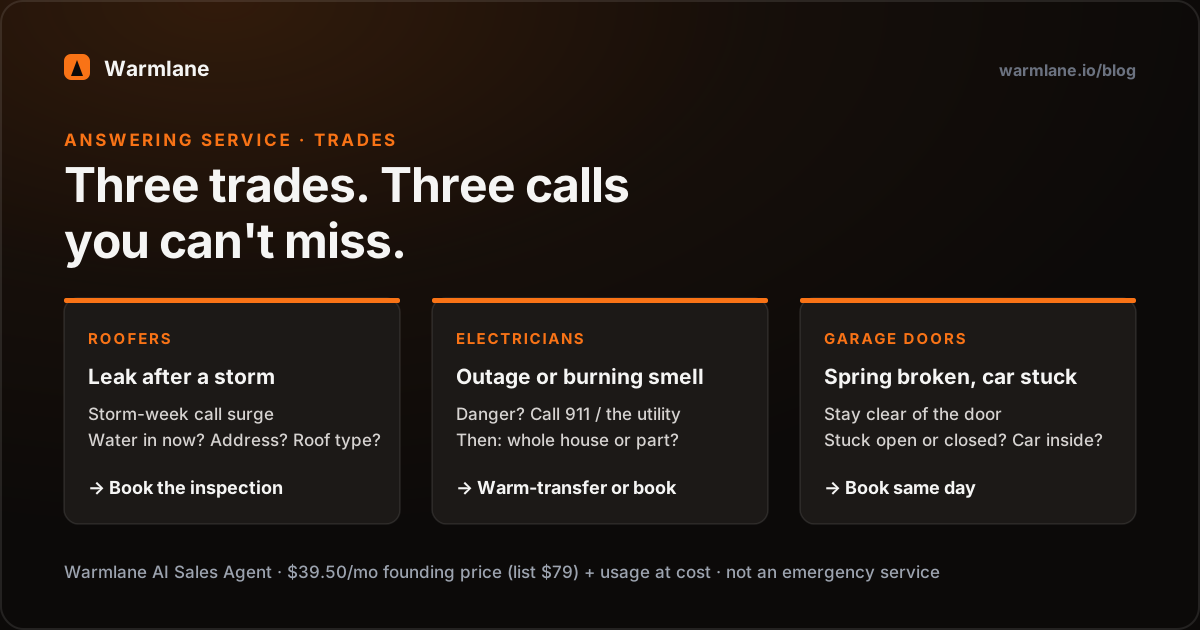
An answering service for roofers, electricians and garage-door companies has one job: pick up the call your crew can't, and turn it into a booked visit before the caller rings the next company on the list. Each trade has its own high-value call - a roof leak after a storm, a power outage or burning smell, a broken spring with the car trapped inside - and the agent needs different questions, prices and escalation rules for each.
Warmlane is an AI Sales Agent: it answers every call, then qualifies the caller, handles the price question and books the job. It costs $39.50/month (founding price for our first 50 customers, locked for life; list $79) plus your own phone and AI usage at cost, roughly $15-20 a month at 100 calls. Human answering services start at $250-$300 a month for 30-50 calls or minutes. For real danger - sparking, smoke, a downed line - the agent tells the caller to call 911 or the utility first; it is not an emergency service.
Why these three trades need their own setup
Most answering-service advice is written for plumbers and HVAC. Roofing, electrical and garage-door work share the same basic problem - you are on a ladder, in a panel or under a door when the phone rings - but the call that matters most looks different in each one.
- Roofers get call surges. After a hailstorm or high winds, a week's worth of calls can arrive in an afternoon, and every one of them is a homeowner who will hire whoever shows up first to look at the roof.
- Electricians get calls that may be dangerous. "My power's out" might be a tripped breaker, a utility outage or a failing panel. "I smell burning" needs a safety instruction before anything else.
- Garage-door companies get calls that are urgent but not dangerous - if nobody touches the spring. A car trapped behind a broken door is a same-day job and a customer who will pay for speed.
A generic "Can I take a message?" fails all three. A good answering service - human or AI - asks the right questions for the trade, quotes your prices, books the visit, and escalates the calls that need you.
Roofers: the storm-week phone
The high-value call: "We had a storm last night and now there's water coming through the bedroom ceiling." That caller is scared, may have already called two other roofers, and will book whoever gives them a time.
Why roofing is different: storm-driven call spikes. Your busiest week is the week you can least answer, and any service that bills per call or per minute charges you most in that exact week.
What the AI Sales Agent should ask:
- Is water coming in right now, and which room? (This decides whether it is a tarp-today job or an inspection-this-week job.)
- What's the address? (Checks your service area before anything else.)
- Roof type and roughly how old - shingle, metal, tile, flat?
- Is this storm damage they plan to claim on insurance? (You decide how to handle that; the agent just records the answer.)
- Best callback number and a time that works for the inspection.
What it should quote: only your own numbers, written in during setup - for example, "Inspections are free within our service area" or "An emergency tarp visit is $X." It never guesses a repair or replacement price; it says a roof can't be priced over the phone and books the inspection.
When it should warm-transfer: active water coming in where you offer emergency tarping, a commercial account, or anyone asking for you by name. Everything else - the 30 "can someone look at my roof" calls after a storm - books straight onto your calendar with a text and email confirmation, and you get a notification with the transcript for each one.
During a storm surge, callers ring at the same time. An AI agent can answer several at once; a one-person office cannot.
Electricians: safety first, then the booking
The high-value call: "Half the house has no power," or worse, "There's a burning smell coming from the panel." The first is a likely same-day service call. The second may be an emergency - and that is not something an answering service should try to judge.
The rule: before any booking question, the agent checks for danger. If the caller mentions smoke, fire, sparking, a burning smell, a buzzing or hot panel, a downed power line, or anyone who has had a shock, the agent says one thing first: if there is immediate danger, hang up and call 911; for a downed line or a wider outage, call your utility. Then, if the caller is safe and still wants help, it warm-transfers to your on-call electrician or books the earliest emergency slot. It does not give any other safety advice.
What it should ask (once the caller is safe):
- Is the whole house out, or part of it? Are the neighbors out too? (If the street is dark, it is likely a utility outage, and the agent can tell the caller to check with their utility - saving you a wasted trip.)
- What were you doing when it happened - new appliance, storm, work in progress?
- Homeowner, landlord or tenant? Who approves the work?
- Address and service-area check.
- Is this a repair, or a planned job like an EV charger, panel upgrade or remodel wiring?
What it should quote: your service-call fee, your after-hours rate if you charge one, and starting prices for common planned jobs if you publish them - for example "EV charger installs start at $X; we'll confirm after a site visit." Planned jobs are where the AI Sales Agent's objection handling matters: when a caller says "that's more than the other quote," it answers with your own pre-written response (licensed, permitted, warrantied - whatever is true for you) rather than inventing one.
The agent can tell callers to call 911 or the utility. It never tells anyone to reset a breaker, open a panel, touch a wire or "check if it's warm." That advice comes from a licensed electrician, on the phone, after a warm transfer.
Call it like a homeowner with a leak in the ceiling would.
Say the storm took shingles off and water is coming through. Ask what an inspection costs and whether someone can come tomorrow. This is our live demo agent - judge it yourself.
+1 (218) 683-631514-day free trial, no card. Founding price $39.50/mo, locked for life for our first 50 customers. Free done-for-you setup.
Garage-door companies: the trapped car
The high-value call: "The spring snapped, the door won't open and my car's inside - I need to get to work." This is a same-day, premium-priced job, and the caller is not shopping around for long. Whoever offers a time first usually gets it.
What the AI Sales Agent should ask:
- Is the door stuck closed, stuck open, or off its track? (Stuck open means the house isn't secure - often a priority.)
- Did you hear a loud bang? (Typical of a broken spring - useful for your tech, not for the caller to act on.)
- Is a vehicle trapped inside, and how soon do you need it out?
- Door size and roughly how old; opener brand if they know it.
- Address, service-area check and a time window.
What it should quote: your service-call fee and, if you publish them, your starting price for common repairs - for example "Spring replacement usually starts at $X, and the tech confirms the price before starting work." It can also handle the price objection with your own answer about parts quality or warranty.
Safety line: garage-door springs are under high tension. The agent should not walk anyone through releasing, adjusting or forcing the door. If the caller says the door is hanging, falling or someone is hurt, the agent tells them to stay clear and call 911 if anyone is injured, then transfers to you.
When it should warm-transfer: a trapped car where you offer immediate dispatch, a door stuck open overnight, or a commercial door at a business that can't open. Routine tune-ups and new-door quotes book straight onto the calendar.
The closest sample we have is a trade call: Hear a 50-second sample call - a dramatized after-hours burst-pipe call with a fictional business and caller - to hear how the triage questions, the quote and the booking flow together. The same structure is what we build for a roofing, electrical or garage-door line.
What the agent must never do
These are the limits we set for every trade agent. Ask any vendor - human or AI - how they handle each one.
- No safety advice beyond "call 911" or "call your utility." No breaker resets, no spring adjustments, no "go up and check the flashing."
- No guessed prices. It quotes only the prices you gave it. Anything else is "the tech will confirm after looking."
- No promises you didn't make. No "we'll be there in 30 minutes" unless that is your written policy.
- No acting as an emergency service. The AI Sales Agent is not one. It points real emergencies to 911 or the utility, then gets you on the line.
- No dead ends. If it can't help, it warm-transfers or forwards the call, or takes the details and notifies you right away. If a caller hangs up mid-call, it calls back and texts them.
With Warmlane, our team writes these rules into your agent during free done-for-you setup - your emergency keywords, your on-call number, your safety line - so they aren't left for you to configure at 10 PM.
What an answering service costs in 2026
Here is a quiet month (100 calls) next to a storm-surge month (300 calls) for a roofing, electrical or garage-door business, using each vendor's published prices.
| Service | Quiet month 100 calls |
Storm month 300 calls |
Books on the call |
|---|---|---|---|
| Warmlane AI Sales Agent | $39.50 + ~$15-20 usage | $39.50 + ~$30-60 usage | Yes |
| Rosie Scale (booking tier) | $149 | $149 | Yes |
| Goodcall | $79 | $154* | Yes |
| Smith.ai (human plans) | $915 | $2,100 | Yes |
| Ruby | $1,725 | Above published tiers | Yes |
Our own arithmetic from each vendor's pricing page, verified 29 September 2026: Rosie (Scale $149/mo, 1,000 minutes, the cheapest Rosie plan with calendar booking and transfers), Goodcall (Starter $79 for 100 unique customers; Growth $129 for 250, then $0.50 each), Smith.ai (Basic $810 for 90 calls then $10.50 each; Pro $2,100 for 300 calls), Ruby ($720/200 min, $1,725/500 min; no overage rate published). Assumes a three-minute average call and the cheapest plan covering each volume. *Goodcall meters unique customers, not calls; we assumed every storm caller is a new customer (250 + 50 x $0.50). Warmlane is the founding price for our first 50 customers, locked for life (list $79), plus your own Twilio and OpenAI usage billed at cost by those providers - about 6 cents per call minute, 10-20 cents for a typical call, plus $1-2/month for the number.
Two honest notes. Rosie's $149 doesn't move between the two months, because 300 three-minute calls fit inside its 1,000 minutes. And Warmlane's usage does rise with volume - by cents per call, not dollars. The structural point stands: a human service that bills per call sends its biggest invoice in the month a storm filled your phone.
For the full method and more vendors, see our AI Sales Agent pricing comparison, and for a plumbing-specific breakdown, what a plumbing answering service costs.
How setup and the free trial work
You don't build anything. During free done-for-you setup, our team writes your trade's questions, your prices, your service area, your emergency keywords and your safety line into the agent's knowledge, connects Google Calendar or Calendly, and points your number at it. You are usually live within a day. It speaks 29 languages, one per agent - a common setup is one English and one Spanish line.
- Day 1: start free, no card.
- Days 1-14: we set it up and it answers your incoming calls. Every caller is captured with name, number and reason, plus a text transcript and AI analysis, exportable to CSV.
- Day 15: add a card to keep going, or the account pauses. Nothing is charged and nothing is deleted.
Two things it does not do, so you aren't surprised: it does not take payments or deposits, and it does not connect to field-service software like Jobber or ServiceTitan - bookings go to Google Calendar or Calendly and leads export as CSV. If you run Jobber or Housecall Pro, read how to add AI call answering alongside them. See pricing and the trades page for details.
When a human service is the better choice
An AI Sales Agent is the right tool for routine trade calls. It is not the right tool for everything.
- If most of your calls are genuine emergencies - a 24/7 emergency-only electrical contractor, or a storm-restoration outfit that dispatches crews overnight - a human service with real judgement is the safer buy, despite the price.
- If your calls are long insurance conversations - adjusters, claim numbers, supplements - a trained human (or you) will handle them better.
- If you need audio of every call for disputes, note that Warmlane keeps text transcripts only, no audio recordings.
- If you get very few calls and answer most of them yourself, a missed-call text-back may be enough. We compare the two in missed-call text-back vs an AI Sales Agent.
The quickest way to find out if it fits is to call the demo agent and act like your worst customer: +1 (218) 683-6315.
Frequently asked questions
What is the best answering service for roofers? +
Can an AI answering service handle electrical emergencies? +
What should a garage door answering service ask a caller? +
How much does an answering service for contractors cost? +
Will the AI quote roof or electrical repair prices? +
Does Warmlane integrate with Jobber, Housecall Pro or ServiceTitan? +
How fast can I get it running? +
Can callers reach a real person? +
Get the next storm week answered.
Start the trial, tell us your trade, service area, prices and on-call number, and we'll have the AI Sales Agent answering your line within a day.
+1 (218) 683-631514-day free trial, no card. Founding price $39.50/mo, locked for life for our first 50 customers. Free done-for-you setup.